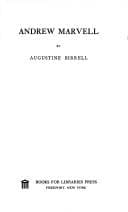
Authors, English -- Early modern, 1500-1700 -- Biography; Marvell, Andrew, 1621-1678
"For if first we consider the State, the kings of England rule not
upon the same terms with those of our neighbour nations, who, having
by force or by address usurped that due share which their people had
in the government, are now for some ages in the possession of an
arbitrary power (which yet no prescription can make legal) and
exercise it over their persons and estates in a most tyrannical
manner. But here the subjects retain their proportion in the
Legislature; the very meanest commoner of England is represented in
Parliament, and is a party to those laws by which the Prince is sworn
to govern himself and his people. No money is to be levied but by the
common consent. No man is for life, limb, goods, or liberty, at the
Sovereign's discretion: but we have the same right (modestly
understood) in our propriety that the prince hath in his regality:
and in all cases where the King is concerned, we have our just remedy
as against any private person of the neighbourhood, in the Courts of
Westminster Hall or in the High Court of Parliament. His very
Prerogative is no more than what the Law has determined. His Broad
Seal, which is the legitimate stamp of his pleasure, yet is no longer
currant, than upon the trial it is found to be legal. He cannot
commit any person by his particular warrant. He cannot himself be
witness in any cause: the balance of publick justice being so
delicate, that not the hand only but even the breath of the Prince
would turn the scale. Nothing is left to the King's will, but all is
subjected to his authority: by which means it follows that he can do
no wrong, nor can he receive wrong; and a King of England keeping to
these measures, may without arrogance, be said to remain the onely
intelligent Ruler over a rational People. In recompense therefore and
acknowledgment of so good a Government under his influence, his
person is most sacred and inviolable; and whatsoever excesses are
committed against so high a trust, nothing of them is imputed to him,
as being free from the necessity or temptation; but his ministers
only are accountable for all, and must answer it at their perils. He
hath a vast revenue constantly arising from the hearth of the
Householder, the sweat of the Labourer, the rent of the Farmer, the
industry of the Merchant, and consequently out of the estate of the
Gentleman: a large competence to defray the ordinary expense of the
Crown, and maintain its lustre. And if any extraordinary occasion
happen, or be but with any probable decency pretended, the whole Land
at whatsoever season of the year does yield him a plentiful harvest.
So forward are his people's affections to give even to superfluity,
that a forainer (or Englishman that hath been long abroad) would
think they could neither will nor chuse, but that the asking of a
supply were a meer formality, it is so readily granted.
Public-domain text, read in full here on John Shaqi.
Reviews
Reviews
No reviews yet
Be the first to share your thoughts on this work.
Elsewhere in the archive
Join the Discussion
Join the discussion
Sign in to leave a comment or review.
Sign InorCreate an account