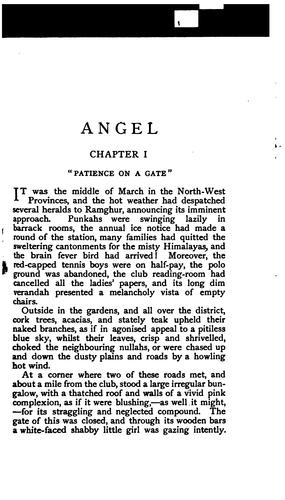
Angel: A sketch in Indian inkCroker, B. M. (Bithia Mary)
History
Angel: A sketch in Indian ink
Croker, B. M. (Bithia Mary)
British -- India -- Fiction; India -- History -- British occupation, 1765-1947 -- Fiction
This aspiration was just beyond the limits of Angel's fortitude; she
put down her screen very quickly, and exhibited a ghastly face, as
she bent over, murmured something to Mrs. Deep Voice, then rose to
her feet, with a faint, "Will you kindly?" to her neighbours, as she
extricated her chair; but she carried her head with the pride of all
the "De Roncevalles," as she walked slowly out of the Chitachar club.
Several men, who were smoking in the verandah, followed the girl's
graceful figure with approving eyes, as she stepped out into the cool
starlight.
"One of the ladies from the camp," remarked one. "She is pretty enough
if she did not look so confoundedly seedy."
There was a clear young moon, as well as the bright stars, to light
Angel back to the tent. Everyone else had their chokedar in waiting,
with his big stick and lantern, as the roads were frequented by
Karites—(a deadly form of small snake resembling a bit of a broken
branch on which the unwary may tread, and die within the hour). Karites
had no respect whatever for the moon—she belonged to them—but they
were afraid of big moons held close to them, accompanied by clumping
sticks, and slid away nervously when they were approaching.
Angel hurried homewards, totally ignorant of her danger, and as she
rushed along, she noticed two figures,—at whom the young moon stared
with merciless severity. They were advancing very slowly—yes, halting
occasionally to talk—but oh, she had no heart for other people's
troubles now. To think of Lola, whom she had detested, giving up
Philip—the idea was almost too immense to grasp—and marrying an
old man, in order to save her family. Oh, what self-sacrifice, what
a common, selfish, every-day creature she was in comparison! Such
nobility was beyond her reach, and if Mr. Waldershare had died a year
sooner, if she had not rushed out so madly and hampered Philip with
herself, he and Lola might have been happy after all. As she stumbled
into her tent, and flung herself on her bed, she was once more the
old emotional Angel, agonising with the misery of her aching heart.
There were three people who were bound to be unhappy—two as long as
she lived and stood between them, and she was the younger by many
years. What a prospect! Angel was experiencing the hopeless agony of
an exceptional soul; the closing of adverse powers round a passionate
strength, that would carve its way freely, and as she crushed her face
into her pillow she moaned:
"Oh, poor Philip—poor Lola—and poor me!"
* * * * *
"What did she say to you?" asked Pink Gown eagerly, as soon as Angel
had trailed away into the verandah. "I never saw such a pair of tragic
blue eyes; she was white to the very lips. Do you think she has been
taken ill? You know that tope is notoriously feverish."
Public-domain text, read in full here on John Shaqi.
Reviews
Reviews
No reviews yet
Be the first to share your thoughts on this work.
Elsewhere in the archive
Join the Discussion
Join the discussion
Sign in to leave a comment or review.
Sign InorCreate an account