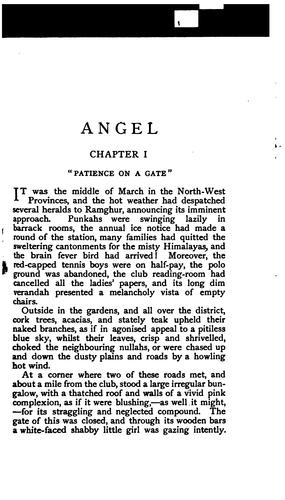
Angel: A sketch in Indian inkCroker, B. M. (Bithia Mary)
History
Angel: A sketch in Indian ink
Croker, B. M. (Bithia Mary)
British -- India -- Fiction; India -- History -- British occupation, 1765-1947 -- Fiction
Sam was a nice, simple, unaffected dog, and a general favourite.
John was stout, well set on his legs, with no approach to style or
pedigree; his head was too round, his nose too short—foolish people
declared he had "a pretty face," and judges admitted that his cat-like
paws were models. He abhorred all endearments and liberties—though
to gain certain ends he could beg and give the paw. He was fond of
music, and came and sat under the piano when Angel played, occasionally
accompanying her in soft, melodious howls. He also sang—to the
mandoline. He was a very duck in the water, which his brother loathed.
He was shamelessly greedy, and Sam was an ascetic. John was immensely
clever, and Sam was a fool. John was self-centred, impulsive, and
irritable. Occasionally he and his twin fought for no apparent reason,
almost to the death, and were only separated by being vigorously pumped
on, or torn, as it were, asunder. They were always badly mauled and
covered with blood; Sam was invariably the victor, and immediately set
himself to lick his brother's wounds, who received this Samaritan-like
attention with sullen toleration. On the sole occasion when John was
the best dog he bore himself most unchivalrously, lorded it over his
vanquished foe for twenty-four hours, and would not suffer him to come
into the presence of their joint mistress, or to approach within six
yards of his fat, vainglorious self.
But John had delivered his brother from the disagreeable consequences
of murder and theft, secured him excellent sport, and on one occasion
saved his life, returning home in the middle of the night, rousing the
household by his terrific howls, and leading forth a rescue party to
where Sam—ever the most enterprising—was smothering in a snake hole.
The couple thoroughly appreciated camp life, and, no doubt, bragged
prodigiously of their feats and escapades to other less lucky dogs whom
they met at the band-stand or in the club compound. At the present
moment they were shivering to be taken out. John sat on his hind legs,
his gaze pathetically fixed on Gascoigne's last piece of toast, for his
greed and presumption were unique. Sam divided his attention between
driving sparrows out of the verandah—those vulgar street boys of the
world—and keeping a sharp eye on his master's movements.
"I say," said Gascoigne, "these fellows have done themselves well in
camp! John is actually bloated; he has the figure of an alderman."
Angel laughed. "But I can't say as much for you," and he looked at her
steadily.
He was thinking how soon India robs a girl of her good looks. Angel was
white, her cheeks were hollow, her features had sharpened.
"I should hope not," she retorted; "surely you don't want _me_ to have
the figure of an alderman?"
"I should like to see a little flesh on your bones," and he reached
over and took up her limp hand and wrist. "What have you been doing to
yourself, Angel?"
"Nothing."
Public-domain text, read in full here on John Shaqi.
Reviews
Reviews
No reviews yet
Be the first to share your thoughts on this work.
Elsewhere in the archive
Join the Discussion
Join the discussion
Sign in to leave a comment or review.
Sign InorCreate an account