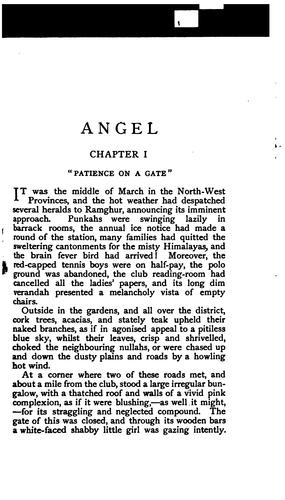
Angel: A sketch in Indian inkCroker, B. M. (Bithia Mary)
History
Angel: A sketch in Indian ink
Croker, B. M. (Bithia Mary)
British -- India -- Fiction; India -- History -- British occupation, 1765-1947 -- Fiction
Colonel Gascoigne suddenly sat down and rested his elbow on the table,
and stared hard at his wife. His mind was a battlefield of conflicting
ideas. Angel had never told him an untruth—no, not even at Ramghur;
and, as for Mrs. Gordon, had she not years of good deeds to speak for
her?
"They are absolutely suited to each other," continued Angel, suddenly
changing her position; she no longer lounged with crossed knees,
dangling arms, and a swinging little satin-clad foot. She sat up, leant
forward with clasped hands and expressive eyes—"yes, they are made
for one another—their ideas and tastes are identical, but that wooden
old wretch, who always recalls the god Odin to me, sits between them
and bars their road to happiness." She drew a long breath. "Yes," and
her voice thrilled strangely, her colour rose and her eyes flashed,
"it seems a perfectly hopeless muddle; there are two lives wrecked for
a life which is selfish, stolid, emotionless, and cruel. If _I_ were
Elinor, I should run away with Alan Lindsay; why should I sacrifice
everything to a greedy, solid block of self, who merely regards his
wife as a cook-housekeeper, without wages—a housekeeper who may never
dare to give warning?"
Gascoigne sat up electrified; was this fiercely eloquent, passionate,
beautiful creature the rather languid, limp, every-day Angel?
"You look amazed," she cried triumphantly, "and well you may. Am I not
preaching heresy, I, a married woman? Since I have told you so much, I
will tell you more. She"—throwing out her arms dramatically—"would
have gone off with Alan only for me." Gascoigne stared at his wife; he
could not speak.
"I am much stronger than I look," resumed Angel; "who would believe
that I, who am but two-and-twenty, could influence Mrs. Gordon, who, as
you once boasted to me, could influence a province!"
"Who, indeed?" he echoed; but when he saw Angel in this exalted mood he
was prepared to believe in her victories.
"She was only drawn gradually to the brink, inch by inch, step by step;
and, oh, she struggled so hard. Alan Lindsay is clever, plausible,
eloquent. I found her on the brink; I sounded the recall—the trumpet
of the assembly of good people, in her ear. I dragged her back by moral
force."
"Yes?"
"She is nearly dead, she is in a state of mental collapse, the fight
was so desperate, the struggle betwixt love and duty so severe. _I_
fought for duty," and Angel nodded her head at her stupefied listener.
"I'm not sure that I shall do it always—I fought well—I turned the
tide of battle. Alan Lindsay has accepted his dismissal and his fate.
As a small, small alleviation, he may write to _me_."
There was a long pause, broken only once more by the girl's thin,
clear voice inquiring: "What have you got to say to me, Philip?"
He rose with a sudden impulse and came towards her.
"I say—that you are an Angel—a wingless Angel," and he stooped down
and kissed her.
"So much for jealousy!" she exclaimed, and laughed.
CHAPTER XXXIV
A REFUGEE
Public-domain text, read in full here on John Shaqi.
Reviews
Reviews
No reviews yet
Be the first to share your thoughts on this work.
Elsewhere in the archive
Join the Discussion
Join the discussion
Sign in to leave a comment or review.
Sign InorCreate an account