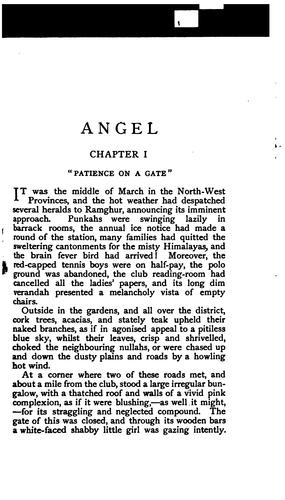
Angel: A sketch in Indian inkCroker, B. M. (Bithia Mary)
History
Angel: A sketch in Indian ink
Croker, B. M. (Bithia Mary)
British -- India -- Fiction; India -- History -- British occupation, 1765-1947 -- Fiction
"The dam—it is gone!" cried Angel, as the sound died away. "There is
not a second to lose; we must fly. Come," and she flung open the door.
As she did so the hut reeled over, and a wave of cold water splashed
across the threshold. Outside, the drizzle, as illuminated by the
lantern, was impregnated with thick red dust, which spread over an
area of ten miles. Lola was still on her knees, as if turned to stone,
apparently paralysed with horror. The flood was rising in the room,
and the hut shivered and trembled like some live thing. "Come, Lola,
you must make a dash for your life," urged Angel, placing the lamp in
the window, and reaching out to help her to rise. "Every moment it is
getting worse."
As Lola staggered to her feet, a wave half filled the hut, and she
seemed to lose her reason, and broke into a shrill, wild, unbroken
scream—it was hardly like the human voice—minute after minute it
continued, and every minute it became wilder and more piercing.
Suddenly Gascoigne stood in the doorway. He had returned from the dam,
only to learn, to his horror, that his wife and Mrs. Waldershare had
gone down to the condemned quarters.
"I can only take one," he said, huskily, and his eyes rested on Angel.
She was farthest away; Lola cowered between her and the door. Lola was
crazy with terror, having the fear of death before her eyes, the sound
of many waters in her ears. As she stood, in a frenzy, panting like
some hunted creature, she was almost unrecognisable, transformed by her
emotions. Her livid face, starting eyes, wet, streaming hair, belonged
to another woman.
"It means—death?" she questioned, with chattering teeth, and read the
tragic answer in the man's set, white face. "Then take—_me_—_me_!"
she shrieked, and she sprang on him like a leopardess, clung to his
neck with locked arms, and the whole weight of a strongly-built,
frantic, desperate woman. He was muscular, and in hard condition,
but could he ever have released himself from that cruel clutch, the
death-grip of mortal fear, the pitiless hold of the drowning? "Oh,
Philip, you loved me first," she sobbed; "save me—save me—_me_."
Angel surveyed this terrible scene with a gaze of wide-eyed horror. Of
course he must save Lola.
"Yes, Phil," she said, coming nearer, and her voice was clear and
decided. "Go; don't waste precious time. Philip, I intend to stay. Save
her first; you can," and she faltered for a second, "come back."
Angel held aloft the lantern as she spoke, and her husband, without a
word, turned, and splashed with his burthen out into the black night;
the water swept him off his feet, for one or two strokes, whilst Lola,
who was now demented, and a dead weight, nearly dragged him under.
"There is Jim Hailes. No, I'm not coming—they say I killed him—no, I
won't die—why should I die? Who said I won his money? There, take it
back—a shocking sight, they said. Don't let the Gascoignes hear—no,
no, _I'm_ not going to the funeral!"
Public-domain text, read in full here on John Shaqi.
Reviews
Reviews
No reviews yet
Be the first to share your thoughts on this work.
Elsewhere in the archive
Join the Discussion
Join the discussion
Sign in to leave a comment or review.
Sign InorCreate an account