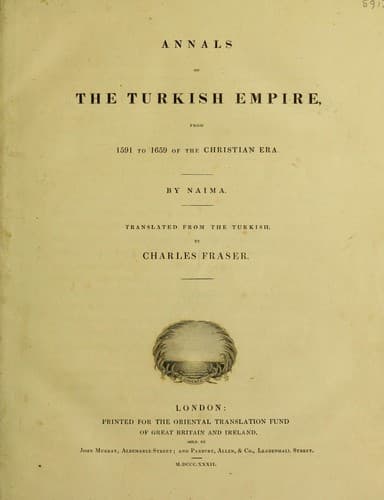
Annals of the Turkish Empire, from 1591 to 1659Naima, Mustafa
History
Annals of the Turkish Empire, from 1591 to 1659
Naima, Mustafa
Turkey -- History -- 1453-1683
Those troops who attacked the infidels on the heights of the mountain
were led on by Delí Nasúh Páshá, the páshá of Uskudár, and who,
descending from his horse, fought on foot with the utmost bravery. It
would be impossible to relate all the heroic deeds which he and his
veteran associates achieved on that day. The day following, however,
the Moslems offered no battle, but attended to their sick and wounded,
and interred those martyrs who had fallen in the mortal contest. On the
second day they again commenced their military operations. The troops
of Romeili and Buda, supported by other divisions, presented themselves
before the enemy’s fortifications, when another desperate struggle
commenced, which lasted till night, as on the former day; but which,
alas! brought no victory to the Moslem arms. The Osmánlís now thought
it advisable, seeing they had been unable to conquer, and because the
winter had set in, which was unfavourable for warlike operations,
to retire and seek their safety in retreat. But lest injury should
happen to the bridges on the Danube and the Drave should they retire
in confusion by them, they chose another way of saving themselves;
and accordingly sent off their heavy baggage on the 28th, and soon
afterwards commenced their retreat, which they accomplished without
sustaining any serious injury. Such was the result of this campaign.
The orthodox troops, with their Serdár at their head, returned by
Armúdlí and Pest, and encamped before the mills near the island of
Koyún (or Sheep Island).
Whilst the camp continued at this place, another deputation arrived
and presented themselves before the serdár, and informed him of the
progress of the Transylvanians against Temiswar. The beglerbeg of Sivás
Mahmúd Páshá, with the Bosnian troops and some Romeilian chiefs, were
appointed to march to the aid of Temiswar, which they did on the 2d of
the second Rabia.
Public-domain text, read in full here on John Shaqi.
Reviews
Reviews
No reviews yet
Be the first to share your thoughts on this work.
Elsewhere in the archive
Join the Discussion
Join the discussion
Sign in to leave a comment or review.
Sign InorCreate an account