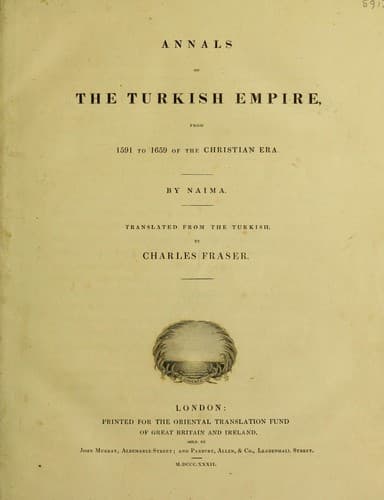
Annals of the Turkish Empire, from 1591 to 1659Naima, Mustafa
History
Annals of the Turkish Empire, from 1591 to 1659
Naima, Mustafa
Turkey -- History -- 1453-1683
Whilst the Páshá and his men stood contemplating the loaded waggons
as they approached nearer, and suspecting no danger, suddenly a body
of troops made their appearance, and fell upon the astonished gazers
without allowing them a moment’s warning for self-defence. These were
Michael’s troops, and they amounted to more than twenty thousand,
whilst those under the command of Háfiz did not exceed three thousand,
and most of them, at that moment, were without any sort of defensive
weapon whatever. The waggons which were said to have been conveying
treasures and presents to the Páshá, turned out to be cannon which
they carried. The Moslems finding themselves thus miserably duped, and
seeing they were unable to resist such a force, had no alternative left
them but either to perish by the hands of these barbarians, or to seek
their safety in flight. This last appeared the most advisable, and they
endeavoured to accomplish it. The Páshá, in a state of madness, mounted
his horse, and all who were fortunate enough escaped to Maternevi.
Alas, many of the followers of Mohammed fell martyrs on that sad day.
The whole of their property and wealth fell into the hands of Michael
the apostate, and of those wretches who followed him.
The odious Michael, after having gained the advantage in the manner
above described, marched on Nicopolis, and laid siege to it; but he was
at length repelled. The struggle between the besiegers and the besieged
lasted twenty days, but the barbarians were at last obliged to retire
without having effected their purpose, and went towards Bekrish.
The unfortunate Páshá, like the rest of his men, lost all he had. It
has been said that some of Michael’s men brought him the garments and
shash which Háfiz usually wore, and that in derision of the Páshá he
put them on a decrepid old woman, whom he presented, thus dressed,
before his men, telling them, that he had caught the Moslem Páshá, and
thus excited their mirth at the poor Páshá’s expence.
The Páshá, however, made his way to Nicopolis, and repaired the
breaches which had been effected by Michael on that fortress. When on
the point of going into winter-quarters at Hazargrade, he received
information from the court of Constantinople that he was succeeded in
the command on the banks of the Danube by the fourth vezír, Mahmúd
Páshá. He accordingly returned to the metropolis about the middle of
Jemadi II., and was honoured with the dignity and office of fourth
vezír in room of Mahmúd.
_The grand Vezírship conferred a third time on Ibrahím Páshá._
Public-domain text, read in full here on John Shaqi.
Reviews
Reviews
No reviews yet
Be the first to share your thoughts on this work.
Elsewhere in the archive
Join the Discussion
Join the discussion
Sign in to leave a comment or review.
Sign InorCreate an account