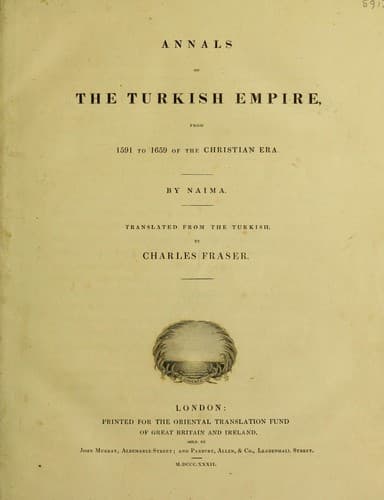
Annals of the Turkish Empire, from 1591 to 1659Naima, Mustafa
History
Annals of the Turkish Empire, from 1591 to 1659
Naima, Mustafa
Turkey -- History -- 1453-1683
It is related by Alája Mohammed Aghá that he himself, at the time
Satúrjí Mohammed Páshá was killed, was present with Ibrahím Páshá when
on his way to Belgrade. His words are: “I was present in an assembly,
called together by the Páshá, when it was announced that Satúrjí
Mohammed Páshá was murdered. The Páshá fell into a great rage, and
asked furiously who had brought the intelligence. ‘It is false: it is
totally without foundation,’ said he, and then again asked the person
who announced it: ‘whence and from whom have you received this story?’
When the informer was about to say that he had been a witness to the
deed, the commander-in-chief broke out again in a furious rage and
said: ‘behold, this infidel utters falsehood in our presence; by the
head of the emperor, if this story turns out to be false you shall be
punished with death.’ After having thus exhausted his fury upon the
informer, he turned to the persons who composed the assembly, and thus
addressed them: ‘Muselmans, what an unlikely story is this! That an
ághá of the Janissaries should be guilty of the murder of so celebrated
a vezír as Satúrjí, without the emperor’s permission and unknown to
me, is unworthy of a moment’s belief: it is false.’ So great, indeed,
was the rage into which he put himself, that he actually foamed at the
mouth like a rabid animal.” The same historian goes on to say, that at
this time he stood before him, and on the páshá’s beckoning to him to
approach him he obeyed. “Go,” said the grand vezír, “and whereever you
find Etmekjí Zádeh take him to your tent and make him your prisoner.”
The narrator adds: “I immediately went in search of him and found him
in the tent of the ketkhodá. On asking him to accompany me he got up,
and we talked together till we arrived at my tent, when I invited him
to step in. He immediately appeared confused”—for this Alája Mohammed
Aghá was the chief executioner—“and asked the reason of his inviting
him into his tent. On informing him of the nature of the firmán which
had been sent to me regarding him, he instantly sent a person to inform
the ketkhodá of what had happened to him. The ketkhodá got into a
violent passion at the conduct of the ághá, and went directly to the
serdár and complained of him. The serdár swore he knew nothing of the
matter, and said it was false. ‘What is the ághá of a regiment,’ said
he, ‘that he should, without my permission, be so bold as to put a
defterdár into confinement;’ and many more words to the same effect.
He then called the ághá, asked him if he had done so and so, and by
whose authority he had so acted; and turning to the members of his
diván, said: ‘look, ye members of the diván, what times have appeared,
that an ághá of a regiment, without right or necessity, should take
it upon him to imprison a public functionary of so high rank as that
of Etmekjí Zádeh! I will certainly have him slain.’ After having thus
poured contumely on the poor ághá, he looked him in the face, and
Public-domain text, read in full here on John Shaqi.
Reviews
Reviews
No reviews yet
Be the first to share your thoughts on this work.
Elsewhere in the archive
Join the Discussion
Join the discussion
Sign in to leave a comment or review.
Sign InorCreate an account