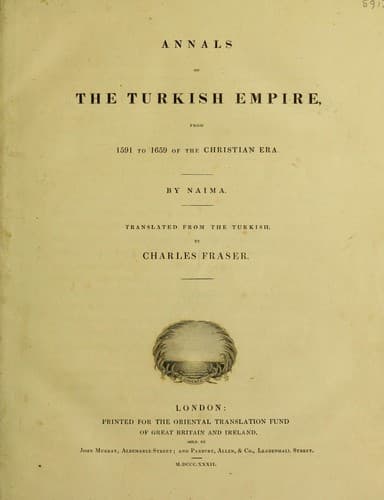
Annals of the Turkish Empire, from 1591 to 1659Naima, Mustafa
History
Annals of the Turkish Empire, from 1591 to 1659
Naima, Mustafa
Turkey -- History -- 1453-1683
On the 15th day of the month, about mid-day, the Moslems were put into
a state of consternation and surprize by a most tremendous report,
and the sight of huge pieces of rock and earth, as large as the human
body, flying through the air, and for the space of two hours Kaniza
was enveloped in smoke and dust. After the smoke and dust had cleared
away, they perceived that one of its two mighty towers had been carried
away. It would appear that the preceding evening, when some of the
Moslem prisoners who had been there confined, had been sent to fill
up some breaches which by this time had been effected, they saw the
door of the powder-magazine standing open, when one of them conveyed a
lighted match into this magazine, and so placed it that it might, in
the course of some hours, reach the powder. This then was the cause
of the Moslems’ surprise. More than one thousand kantars[8] were thus
ignited, and produced the explosion described, carrying off by its
irresistible force the tower already mentioned, the prison in which
lay one hundred and seventy Moslem captives, women and children, the
arsenal, and the palace of the prince or governor, and himself along
with it. For several days after this catastrophe no guns were fired
from the fortress, but they continued the use of their musketry.
In their distress and great amazement they sent word to the king (of
Hungary), informing him of what had befallen them, and beseeching him
to render them his aid.
Ferdinand, emperor of Germany, who had collected his troops with the
view of visiting Buda, heard that Hasan Páshá was there, and therefore
came with his whole army, which amounted to forty thousand foot and
horse, to the aid of Kaniza. His advance guard appeared on the 28th,
and the whole army took up its position in the neighbourhood of Kaniza.
The Moslem cavalry, eager to meet these infidels, advanced upon them;
but such was the briskness of the enemy’s musketry, that they were
obliged to retire. The janissaries now left their trenches, though the
Frenchmen remained in theirs, and advanced in their turn, but were soon
forced to retrace their steps and fly. The courage of the Moslem camp
was supported by the unfurled banners of the begs and governors at the
head of their respective troops. The enemy took good care, however,
not to play the same game they had played at Mehaj after the fall of
Agria, _i. e._ by rushing on the Moslem camp. They so placed their
guns as to make them tell more effectually upon the orthodox army; but
fortunately the balls passed over their heads. A whole day was spent in
hard skirmishing, when, towards night, the enemy retired within their
fortifications, and spent the whole of that night in strengthening
their position by means of ditches, mounds, &c. Next morning, the
infidel foot soldiery, with their cannon in front of them, advanced
to the charge. The Moslem commander-in-chief mounted on horseback,
arranged a body of his men behind a marsh: the janissaries and the
Public-domain text, read in full here on John Shaqi.
Reviews
Reviews
No reviews yet
Be the first to share your thoughts on this work.
Elsewhere in the archive
Join the Discussion
Join the discussion
Sign in to leave a comment or review.
Sign InorCreate an account