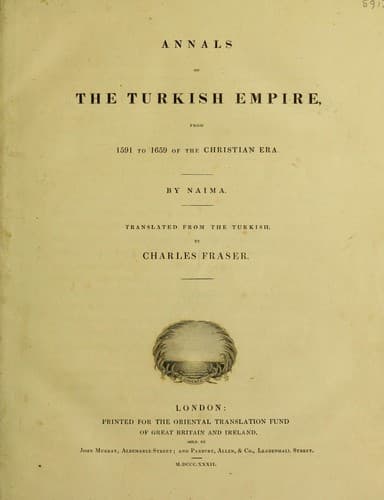
Annals of the Turkish Empire, from 1591 to 1659Naima, Mustafa
History
Annals of the Turkish Empire, from 1591 to 1659
Naima, Mustafa
Turkey -- History -- 1453-1683
The enemy lay between two mountains, and had an immense ditch in front.
The Moslem army advanced, threw a bridge over the river which issued
from a lake, crossed this river on the following day, and attacked
the enemy in their tabúr or fortifications. The great and small guns
were put into immediate requisition. On the following morning, at
daybreak, the combatants on both sides were in motion, and the work of
destruction was again renewed and carried on till the darkness of the
night made it necessary for both parties to retire.
According to Hasan Beg Zádeh’s account of this battle, it would appear
that the janissaries, on the last of the days above-mentioned, when led
on to the attack by the commander, had fled before the opposing foe,
and were on the very point of making the commander their prisoner. God
protected him.
Petcheví says, that Mohammed Ketkhodá having secured an advantageous
position, slew immense numbers of the enemy. The enemy now advanced in
four columns, each column five hundred strong, and drove the Moslem
cavalry off the field. The salihdárs were ordered to advance to oppose
their progress, but were unable to effect any thing: night, however,
came on, when both parties retired from the conflict for a few hours,
but it was soon after renewed with double fury. In this day’s work of
death, towards evening, Mohammed Ketkhodá and Mohammed Munker Kúshí
Páshá, the governor of Buda, whilst advancing with their divisions to
an attack, fell in the field of battle.
According to Hasan Beg Zádeh and Abdulkádír’s accounts of this battle,
it appears that the Romeilian troops had been ordered to support the
attack in which the two chiefs now mentioned met their death, but that,
in consequence of some rancour which their commander, Mohammed Páshá,
entertained against Khetkhodá, they had failed: neither did any of
the other troops, they say, offer to do it. Petcheví says, however,
that he himself was present and an eye-witness: his words are, “I was
standing beside the páshá and looking at the contest. The páshá (_i.e._
the beglerbeg of Romeili) was not aware when this attack was made, and
therefore could not have rendered them any aid. After the return of the
divisions which they had led on to the attack, the martyrdom of these
heroes was announced to him, and he was excessively grieved that they
had advanced to that attack without having given him notice of it. Any
account of the matter differing from this is false.”
On the night of the last battle the enemy altered their position; for
when the Moslems, next day, moved slowly to meet their antagonists,
they found them closely concentrated in a narrow pass in the road
which led to the fortress of Polatah. Finding them thus situated, and
seeing they had succeeded, during the night, in casting a deep trench,
the Moslem army did not again offer to attack them. Under pretence of
winter having set in they retired altogether from the scene of contest
and battle.
Public-domain text, read in full here on John Shaqi.
Reviews
Reviews
No reviews yet
Be the first to share your thoughts on this work.
Elsewhere in the archive
Join the Discussion
Join the discussion
Sign in to leave a comment or review.
Sign InorCreate an account