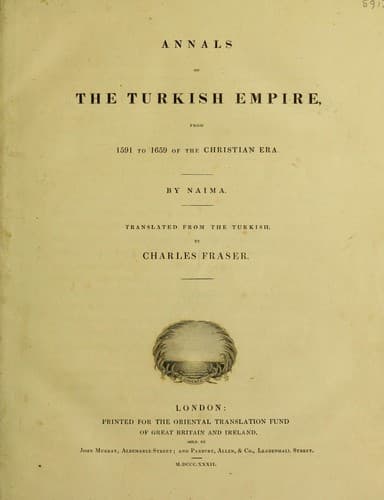
Annals of the Turkish Empire, from 1591 to 1659Naima, Mustafa
History
Annals of the Turkish Empire, from 1591 to 1659
Naima, Mustafa
Turkey -- History -- 1453-1683
The enemy having made no speed in their method of operations, thought
proper to change it. They recrossed at a place called the ford of
Mohammed Khetkhodá, and in the direction of Sigetwar effected mounds
and ditches to the number of fourteen, leaving, in the direction to
Vienna, where they had first taken up their position, five pieces of
ordnance and six thousand troops. After having accomplished these
manœuvres, they now began to throw vast quantities of rushes into
the Berk, over which a covering of wicker-work was placed. Over this
again they finally, though it took them more than forty days to
accomplish, made a kind of road or bridge corresponding in breadth to
one of their ditches, with which it communicated. They carried their
materials by means of light barrels made of fir, which were easily
dragged by two men. After having extended this road or bridge to the
walls of Kaniza, to which they firmly fixed it by means of iron rods,
and when all things were nearly in a state of readiness for commencing
an assault, Hasan Páshá, who was no careless observer of their
manœuvres, and who knew when and how to baffle the enemy, sent a few
heroes, who had volunteered their services, in a boat by night, when
the infidels were drowned in sleep, to set fire to their huge labour,
and which they punctually did. The bridge, and every living infidel who
happened to remain on it, perished in the flames.
Some time before this event in the history of this memorable siege,
Hasan Páshá wrote again to the commander-in-chief by the aforesaid
Punjeh. In these communications he urged Yemishjí Páshá to come at
least to Sigetwar, that by doing so he might encourage the spirits of
the besieged. “If this fortress should happen to be taken out of our
hands,” said he, “it will not easily again be retaken, and you will
find some difficulty in exonerating yourself.” Karah Punjeh proceeded
with this message, taking his two former companions along with him from
Sigetwar, where they had stopped, and met the serdár at Usk. Instead of
complying with the earnest request of Hasan, and fulfilling his former
promise, the serdár only sent him an encouraging letter, telling him he
was on his march to Alba Julia, but would, on his return, afford him
the aid he demanded. Karah Punjeh returned to Kaniza, and delivered,
secretly, his dispatches to Hasan Páshá, who, on reading them,
immediately had them copied, and added, as if from the serdár, that
he would soon arrive to the aid of the garrison. Next day he called a
council, made this copy, or rather forged letter, to be read in their
hearing, which produced all the effect the sagacious páshá wished. The
people were overjoyed, and resolved, every man of them, to hold out, at
the expense of life and all that was dear to them, to the very last;
but they anxiously looked for the arrival of the serdár.
Public-domain text, read in full here on John Shaqi.
Reviews
Reviews
No reviews yet
Be the first to share your thoughts on this work.
Elsewhere in the archive
Join the Discussion
Join the discussion
Sign in to leave a comment or review.
Sign InorCreate an account