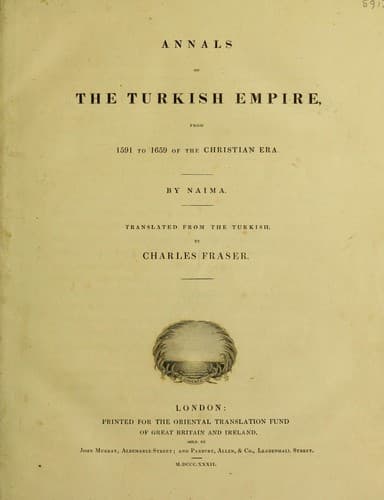
Annals of the Turkish Empire, from 1591 to 1659Naima, Mustafa
History
Annals of the Turkish Empire, from 1591 to 1659
Naima, Mustafa
Turkey -- History -- 1453-1683
These tidings greatly alarmed the inhabitants. “The serdár has been
defeated; our provisions and our gunpowder will fail us if that mighty
army should come against us,” said the frightened inhabitants to Hasan
Páshá, the intrepid governor, who had a mind ready to act in every
emergency. “My brave veterans, you all know,” said he, “that the
accursed enemy has promised us nothing. Do not let the sight of the
heads of the infidels, or their threatenings, by any means terrify you.
I have a few things to say to you—hear me, therefore, patiently. Renew
your engagements with me. Whether the heads which the infidels have
shown you be really the heads of the persons they have said they are,
is yet to be discovered. To ascertain this, let us send Karah Punjeh,
who will bring us correct information on this point. And should it even
turn out that they are the very heads of the two men above-mentioned,
that is no reason why we should be any way discouraged. It is not
on their account we have shut ourselves up in Kaniza. Long live the
emperor! If the meanest slave were desired to sacrifice his life, he
would willingly give his head, as those men gave theirs. We are here
for the defence of our religion, though now cooped up within the narrow
limits of this place. But I have some reason to think that this city
and fortress, God willing, will not fall into the hands of the enemy.
One of my reasons is as follows. When Ibrahím Páshá was, on a former
occasion, employed for the same length of time we have been besieged
in reducing a fortress, he would never have gained the victory, had he
not said: ‘if God will prosper my undertaking, I shall devote this
place to the illuminated city, Medina;’ when shortly afterwards it fell
into his hands. It is hoped that he who has devoted himself to the
Sultán of the prophets will not fall before the infidel. Another reason
is: the enemy commenced the siege on the night of the 12th Rabia I.,
which is the birth-night of our prophet. There is, therefore, hope to
his followers, who have been besieged on the very night which is held
sacred to the memory of him who came into the world on that night to
bless it, and is the rejoicing of all the prophets. Again: you, every
evening, sound the Mohammedan signal or watch-word, _Allah! Allah!_ and
though the enemy were at once to discharge his forty pieces of cannon,
yet God will manifest his care over those who trust in his name. I
pray God, that as he has not permitted us to fall into the hands of
the enemy, so this hateful army may never get away in safety.” This
speech of the páshá had a powerful effect on the minds of the besieged,
who were not only animated by it, but also prognosticated important
good from it. He again counselled them to pay no regard to the words
of their morning visitors, who had no other object, he said, but that
of deceiving them. “Show them your swords,” cried he again, “and these
dastardly fellows will see what metal you are of.”
Public-domain text, read in full here on John Shaqi.
Reviews
Reviews
No reviews yet
Be the first to share your thoughts on this work.
Elsewhere in the archive
Join the Discussion
Join the discussion
Sign in to leave a comment or review.
Sign InorCreate an account