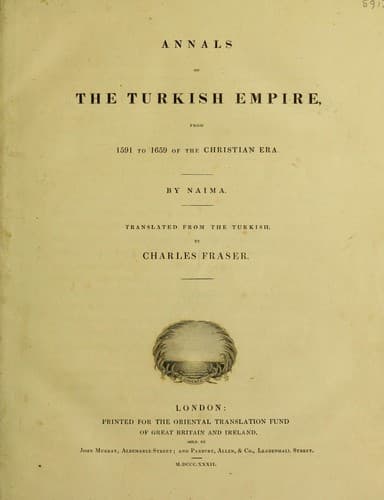
Annals of the Turkish Empire, from 1591 to 1659Naima, Mustafa
History
Annals of the Turkish Empire, from 1591 to 1659
Naima, Mustafa
Turkey -- History -- 1453-1683
We have already related the enemy’s determination of wintering at
Kaniza, and what preparations they had made for this purpose: also, how
Karah Punjeh had deposited the deceptive letter in the enemy’s camp,
and his subsequent journey to the commander-in-chief to obtain aid for
the Kanaizians. The serdár made many promises; ordered the troops under
his command to be paid their wages, and said he would set out next
morning for Kaniza. His officers, however, remonstrated against his
resolution, by alleging that the weather being so very bad the thing
could not be even attempted. The serdár appeared determined, and swore
to the messengers, Karah Punjeh and his two companions, that though the
army to a man should refuse to go to the aid of Kaniza, he and his own
suite would most assuredly go. The messengers returned with this answer.
The enemy, as before observed, had surrounded their camp with a
ditch. The Austrian and other European troops were separated from
the Hungarian army, and the former were determined to reduce Kaniza,
whatever it might cost them. The Italian and French soldiers had become
so very inveterate, that they said they had come from their own country
to die, and that, therefore, they would not remove one step from Kaniza
before they had taken it.
On the seventy-fifth day of the siege, about mid-day, the heavens
became black with clouds, the wind blew from the south, and soft
showers of rain began to fall. Previously to this not a drop had fallen
for the space of three months. The rain now increased, and a most
bitterly cold wind began to blow, which made the surface of the waters
to freeze. Towards evening the rain became mixed with flakes of snow,
and about midnight the rain ceased, but the snow continued to fall.
This storm continued for three successive days and nights, and the fall
of snow was so deep as to reach a man’s waist. The enemy was now in
a very sad plight; but they were infatuated, and in their infatuation
ceased not from their hostilities.
Public-domain text, read in full here on John Shaqi.
Reviews
Reviews
No reviews yet
Be the first to share your thoughts on this work.
Elsewhere in the archive
Join the Discussion
Join the discussion
Sign in to leave a comment or review.
Sign InorCreate an account