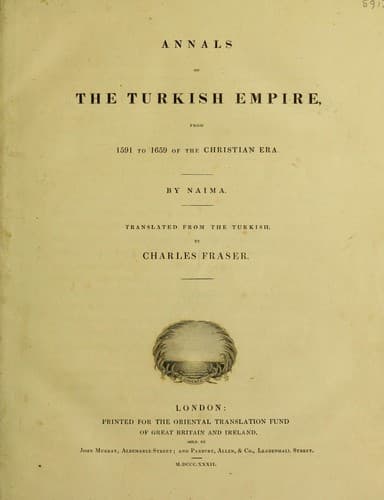
Annals of the Turkish Empire, from 1591 to 1659Naima, Mustafa
History
Annals of the Turkish Empire, from 1591 to 1659
Naima, Mustafa
Turkey -- History -- 1453-1683
Many of the illustrious European young men who were employed in this
war lost their hands and feet by reason of the severe frost; and
several of them were killed in order to relieve them from pain and
sufferings. The Franks formerly mentioned purchased, at a low price,
about two hundred of the Spanish and Italian prisoners.
Before the spring of the following year commenced, about three thousand
villages put themselves under the protection of the Ottomans; and more
than two thousand peasants came from Usk, from Púzgha, from Petcheví,
from Shuklúwish, and from Bosnia, to repair the fortress of Kaniza.
Its outer works these labourers greatly enlarged and strengthened with
trees cut down for the purpose. They surrounded the whole with a line
of fortifications; erected minarets on its walls; built a mosque, a
palace, and an arsenal within the citadel; erected sheds over the guns,
and made a new bath. The successful warriors, however, never ceased to
make excursions into the enemy’s territories, almost as far as Vienna,
and uniformly returned with much booty and many captives.
_State of matters in the East.—Concerning Scrivano._
It had been determined by the court of Constantinople that Hájí
Ibrahím Páshá should go and have an interview with the late governor
of Baghdád, Hasan Páshá, the commander-in-chief in the east, and,
along with him, attack Karah Yázijí (Scrivano). Instead of paying
regard to these injunctions, however, he marched directly to Cæsarea,
where he gave the rebels battle, was routed, and at last obliged to
take refuge in the fortress of Cæsarea. When Hasan Páshá heard of this
terrible disaster, he, without loss of time, removed to Elbastan on
the 12th of Sefer of this year, met the rebel army at a place called
Sepetlú, where he arranged his troops in order of battle. The enemy did
not decline the combat. Early next morning at sun-rise the two armies
commenced a bloody contest, which continued without intermission till
after mid-day, when victory declared itself in favour of Hasan Páshá.
The rebels were routed with great slaughter, leaving one third of their
number, which had amounted to 30,000, lifeless on the field of battle,
besides the whole of their tents and baggage. Karah Yázijí fled with
the remnant of his broken forces into the Jánbeg mountains, where he
fortified himself. The victorious páshá pursued the rebels as far as
Tokat.
_Some other events of this year.—Karah Yázijí dies in the mountains of
Jánbeg._
Towards the end of Jemadi II. information was brought to the Moslem
authorities by some of the rebel chiefs, that Karah Yázijí had died in
the mountains, whither he had fled, in the month of Ramazán, but that
his brother, Delí Hasan, had succeeded him in the command of the rebels.
Public-domain text, read in full here on John Shaqi.
Reviews
Reviews
No reviews yet
Be the first to share your thoughts on this work.
Elsewhere in the archive
Join the Discussion
Join the discussion
Sign in to leave a comment or review.
Sign InorCreate an account