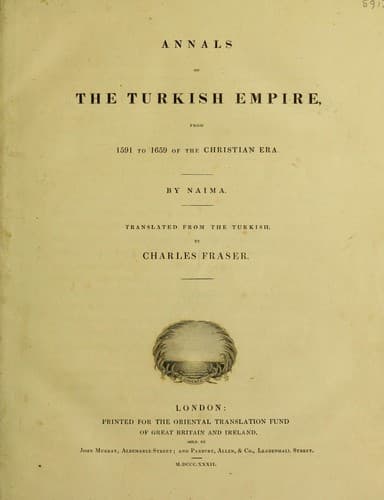
Annals of the Turkish Empire, from 1591 to 1659Naima, Mustafa
History
Annals of the Turkish Empire, from 1591 to 1659
Naima, Mustafa
Turkey -- History -- 1453-1683
We have still to observe one other circumstance before commencing to
relate the events of the following year. During the time that Khalíl
Páshá was governor or deputy of Constantinople, the ulemá assembled
together, waited on his excellency, and demanded justice against the
spáhís for the disturbance and tumult which they had been the means
of raising in the metropolis lately. A report of the whole of their
proceedings was laid before his majesty, who issued a royal letter
relative to this meeting.
Ibrahím Khán, the valas pádisháh, was this year subdued by Sháh
Abbás.[10]
EVENTS OF THE YEAR 1011, H.
_Hasan Páshá recovers Alba Julia._
Towards the end of the preceding year the páshá made every preparation
for commencing a new campaign in the beginning of this year. A new
bridge was erected on the Save: he was joined by the ághá of the
janissaries from Constantinople about the commencement of Moharrem,
and troops from all quarters poured into his camp. The troops that
accompanied the ághá from the metropolis received double wages:
provisions were distributed, and vessels laden with the same article
were sent off for Buda. The royal camp, in the greatest haste,
removed from Belgrade and arrived at Serim on the 15th of the month.
Badalooshka cannon were transported from Buda to the camp, and on the
22nd Alba Julia was put under siege. Lála Mohammed Páshá, from Buda,
encamped on the south side, in front of the city; the grand vezír
(_i.e._ the commander-in-chief, Yemishjí Hasan Páshá) took up his
position on one side, and the ághá of the janissaries, with nine pieces
of ordnance, presented himself before the gate. Mohammed Páshá, with
the army of Romeili and five pieces of ordnance, and Dervísh Páshá, the
beglerbeg of Bosnia, with the army of Buda, entered into entrenchments,
and immediately erected mounds. Three thousand chosen men and four
thousand pioneers were under the immediate eye of the grand vezír.
After a few days of constant battering, the besieging army sprung four
mines, which had some considerable effect, and soon afterwards they
took possession of the large tower, but were obliged to relinquish it.
The enemy, besides, had formed a kind of wall or mound within their
ramparts, which served to protect them against the besieging army’s
artillery. No great progress had hitherto been made.
Public-domain text, read in full here on John Shaqi.
Reviews
Reviews
No reviews yet
Be the first to share your thoughts on this work.
Elsewhere in the archive
Join the Discussion
Join the discussion
Sign in to leave a comment or review.
Sign InorCreate an account