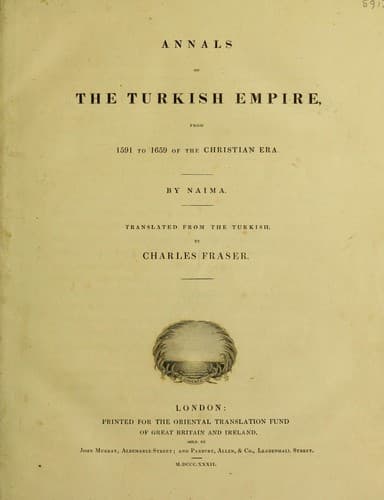
Annals of the Turkish Empire, from 1591 to 1659Naima, Mustafa
History
Annals of the Turkish Empire, from 1591 to 1659
Naima, Mustafa
Turkey -- History -- 1453-1683
As the orthodox Moslems used to call out every evening, _Allah! Allah!_
so also the infidels cried out from one certain place, every morning
and evening, the word _Yesú_, and immediately after this discharged
their large cannon. _Yesú_ is a corruption of _Isa_ (Jesus) in the
gospel. The sound of the guns fired by the infidels was heard at Pest.
Súfí Sinán Páshá was appointed commandant of Buda, for Kází Zádeh Alí
Páshá, the beglerbeg of Buda, who had been present at the siege of
Alba Julia, was there wounded by a musket-ball, and carried off the
field in a litter or sledge. This Alí Páshá came along with Hábel
Effendí, the cazí of Buda, to the serdár, and remonstrated against
leaving Buda defenceless. You will not be two stages distant, said
they, before the infidels will come and surround us. The danger of this
circumstance seemed to press very much upon their imagination, and
they did not fail to paint it in lively colours to the serdár. “Though
it be perfectly true,” said the serdár in return, “that we hear the
sound of the enemy’s cannon, yet it would be very unwise to leave Ardil
Oghlí (_i.e._ the prince of Transylvania) in possession of Lipovah
and Yanovah in the jurisdiction of Temiswar. There are only about six
or seven thousand troops in the enemy’s camp, and their object is
to terrify the Moslem army from entering Transylvania. They are not
sufficiently strong to offer to attack you. You have no reason whatever
to fear they will do so; be therefore easy in your minds on this
score.” Thus did the serdár endeavour to soothe their terrors; but Alí
Páshá replied: “My lord, allow me to inform you that some spies sent
out by me returned last night, and informed me that there are more than
eighty thousand soldiers and forty pieces of ordnance in the enemy’s
camp, and that their object is to attack Buda. Let Hábel Effendí note
down what I have now said, and if it turns out to be false, then you
may take what vengeance you please on me.” Yemishjí Páshá himself, a
proud obstinate Albanian, remained immoveable in maintaining his own
assertions, _viz._ that the enemy had no other view than merely to
frighten them from entering Transylvania, and that they had neither
strength nor intention to attack Buda. In the meantime, when Mohammed
Páshá, beglerbeg of Romeili, perceived the serdár’s obstinacy, he asked
to be permitted to make an excursion as far as Filk and Sitchan, and
carry thence what plunder he might be able to take. His request was not
acceded to; and the following day, the first of Rabia II., the serdár
marched off for Solnuk, which he reached in four days, carrying along
with him five pieces of cannon and one hundred sháhs (a kind of smaller
ordnance). In four days more he crossed the Tise, and on the 11th of
the same month reached the palanka of Sarwash. The troops of Julia and
Temiswar joined his camp at this place; but he had scarcely time to
hold a council of his great men, when, behold! messengers with evil
Public-domain text, read in full here on John Shaqi.
Reviews
Reviews
No reviews yet
Be the first to share your thoughts on this work.
Elsewhere in the archive
Join the Discussion
Join the discussion
Sign in to leave a comment or review.
Sign InorCreate an account