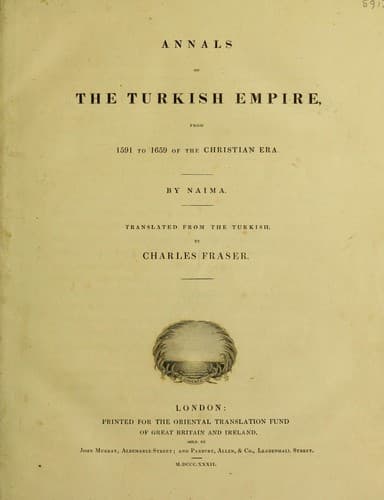
Annals of the Turkish Empire, from 1591 to 1659Naima, Mustafa
History
Annals of the Turkish Empire, from 1591 to 1659
Naima, Mustafa
Turkey -- History -- 1453-1683
But soon a fire broke out within them, which not only destroyed every
thorn of doubt, but also burned up all the rubbish of their suspicious
speculations, with regard to the point to be gained, when again,
with redoubled valour, they set their faces firmly to the contest,
and fought with such desperate courage as can hardly be described.
The contest, however, was most unequal: a few hundreds against many
thousands; but yet a most bloody one. Many a sultán’s head remained
bonnetless on the field of battle; many a khán’s family was left
unprotected in this most desperate struggle, which lasted from sun-rise
till mid-day. True it is that the Tabrízians are a most bold, fierce,
and heroic tribe; and yet, notwithstanding these qualities which shone
in them so conspicuously on the above occasion, their caution and
acuteness was such, that only ten or fifteen of them tasted the cup of
martyrdom, a circumstance which seems truly wonderful. It is recorded,
that a man of immense strength, belonging to the Tabrízians, vanquished
by his sword about sixty of the enemy, the greater part of whom he made
thorns and briars for the fire of hell.
The result of the bloody contest we have to record was fatal to the
Tabrízians. The hateful heretics, like a multitude of ants, ran upon
their antagonists and overcame them by dint of numbers. On that
lamentable day, Mohammed Páshá, who had formerly been governor of
Nakhcheván, and the beglerbeg of Akhiska, Khalíl Páshá, after having
blotted out of the book of life many of the red heads, fell martyrs on
the field. Alí Páshá, himself a Tabrízian, the válí of the province,
performed, on the above day, the most incredible acts of bravery
recorded in history. The sháh himself could not help admiring the
heroism which inspired Alí Páshá, and spoke with approbation of the
wonderful feats he performed before him. In short, the sháh himself
declared that had there not been treachery somewhere, the victory would
not have been so easily won. Such of the brave Tabrízians as had not
the good fortune of falling in battle contending with these hateful
heretics were, of course, subjected to a fate which they esteem truly
vile and abject. They were made prisoners.
The city and fortress of Tabríz, about the middle of the first Jemadi,
after a siege of twenty-two days, yielded, on the conditions of their
persons and property being respected. These the heretics promised,
but failed most shamefully in fulfilling them. As soon as they got
possession of Tabríz, they began to plunder and rob the inhabitants
without mercy, made their persons slaves, and furthermore began to
annoy them with the delirium of their heresy. The cazí effendí of
the city, not choosing to submit to heretics, fled the city, and
endeavoured to make his way to Wán, but he was pursued by some of the
red heads, who cruelly murdered him on the road.
Public-domain text, read in full here on John Shaqi.
Reviews
Reviews
No reviews yet
Be the first to share your thoughts on this work.
Elsewhere in the archive
Join the Discussion
Join the discussion
Sign in to leave a comment or review.
Sign InorCreate an account