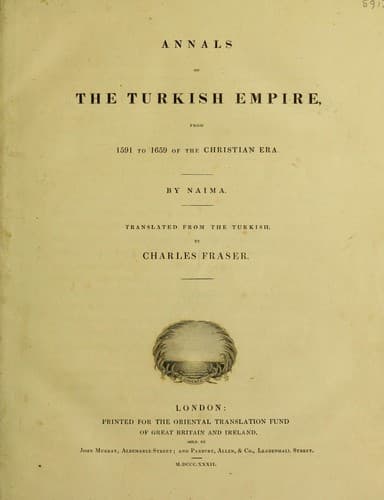
Annals of the Turkish Empire, from 1591 to 1659Naima, Mustafa
History
Annals of the Turkish Empire, from 1591 to 1659
Naima, Mustafa
Turkey -- History -- 1453-1683
Several other places were subjected in a similar manner, and the
heretics spared no means whatever in accomplishing their purposes
against the Osmánlís. Information reached Nakhcheván of the success
which had attended the enemy every where, and of the tyranny and
oppression they exercised over the lives and fortunes of those who
had been so unhappy as to fall into their hands. The Nakhchevánís
were greatly distressed, and fear seized them. However, a reverse of
fortune seemed to be awaiting the orthodox believers. Kesáb Hájí,
who had subdued Urdúbád, remained in it as governor and commander in
the name of the sháh of Persia, but his exaltation was not of long
duration. The válí of Reván, Sheríf Páshá, an aged and experienced
general, perceiving the general defection, and that there was no end
to it, was roused to indignation, and determined on endeavouring to
stop the torrent that seemed to threaten the whole of the Osmánlí
dominions in that quarter. He accordingly deputed Mohammed Páshá, son
of Khezer Páshá, to march against Urdúbád with five or six hundred
veterans and surprise its new governor. These veterans, with the speed
of messengers of death, arrived one morning before daylight at the
place of their destination, and, as a visitation from heaven, fell upon
the wretched heretics with such sudden fury and effect, that only a few
of them escaped the edge of the sword. Those of them who did escape
the vengeance of the orthodox Moslems, fled into holes and caves in
the mountains and in the fields and hid themselves. Kesáb Hájí, who
by some means or other had been deprived of his horse, scampered off
from the scene of carnage, and, like a fox, secreted himself in a den,
leaving his associates to struggle the best way they could: but it was
to no purpose; he did not save himself; for one of the veteran Moslems
having perceived him, followed him into his hole, and seized him. His
associate in the government of Urdúbád, one Beyendur, suffered the
death due to his villany and crimes; but Kesáb Hájí himself, though he
was afterwards put to death, had the honour of having a crown of infamy
placed on his head, was dragged by Mohammed Páshá to the residence
of the válí, and along with the whole of the severed heads of the
infidels of Urdúbád, was presented in his presence. The judicious and
experienced válí failed not to pay all due respect to the hero of the
victorious Moslems.
It is worthy of remark, however, that the enemy no sooner came to know
of the movements of the Moslems, in reference to Urdúbád, than they
sent off a considerable force in the view of succouring the heretics in
it, in the event of the Moslems offering to subdue that city. They were
too late, however, to gain their object, and when they heard of its
fate they retraced their steps.
_The capture of Nakhcheván._
Public-domain text, read in full here on John Shaqi.
Reviews
Reviews
No reviews yet
Be the first to share your thoughts on this work.
Elsewhere in the archive
Join the Discussion
Join the discussion
Sign in to leave a comment or review.
Sign InorCreate an account