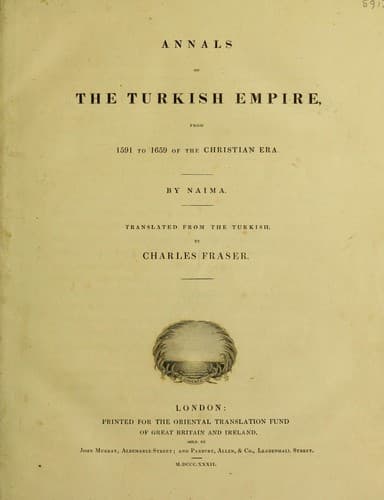
Annals of the Turkish Empire, from 1591 to 1659Naima, Mustafa
History
Annals of the Turkish Empire, from 1591 to 1659
Naima, Mustafa
Turkey -- History -- 1453-1683
Such were the alarming accounts which, at this period, troubled the
Sublime Porte; but they were no sooner received than the káímakám, the
civil and military governor of Constantinople, immediately despatched
an officer to assemble together the mufti, the vezírs and the military
judges, in order to lay these important matters before them. This
council, after having fully considered the various topics which had
been submitted to them, sent a report of their deliberations to his
august majesty, who was pleased to express his approbation of their
resolutions. Sáa’tjí Hasan Páshá was, accordingly, appointed to the
chief command in the east: and whatever number of troops and apparatus
of war he might require for effectually repelling the heretics, were
likewise ordered to be sent to him forthwith. An imperial edict, in
conformity with these resolutions, was immediately issued to the
various commanders in the eastern provinces; but in consequence of the
emperor’s translation to another world, an event which took place soon
after the issuing of the above edict, the preparations in favour of
Sáa’tjí Hasan Páshá were necessarily postponed for awhile.
_Death of Sultán Mohammed Khán, son of Murád Khán._
On the 22d of Jemadi II., as the emperor, Sultán Mohammed Khán, was
returning to his royal palace from some place where he had been, he was
met by an inspired person, at the head of the street which conducted
to his royal mansion, who cried out, that in fifty-six days a very
important event would happen, and then warned his majesty to take care
of himself. This extraordinary and unexpected mode of salutation not
only surprised his august majesty, as well it might, but also the
whole of the citizens. It so happened, that on the 14th of Rajab the
emperor’s constitution became so very much altered and weakened as
altogether to baffle the skill and advice of his medical advisers.
Nothing that they could devise had the least effect in affording him
any relief, and in four days afterwards, on the 18th of the above
month, his triumphant spirit, in the thirty-seventh year and eighth
month of his age, took its flight to the upper world; having reigned
nine years and two months.
Sultán Ahmed Khán, the heir apparent, was declared his father’s
successor, and early on the following morning, the whole of the vezírs,
emírs, and other magnates of the state, assembled in the royal diván to
express their allegiance to the new emperor, and to do him the honours
peculiar on such an occasion. The royal coffin for the deceased monarch
was brought into the court of the palace, where an immense multitude
had collected to hear the funeral service performed by the reverend
mufti, Mustafa Effendí. This ceremony being over, the royal remains
were removed and deposited in a tomb in St. Sophia, near that of Sultán
Selím.
Public-domain text, read in full here on John Shaqi.
Reviews
Reviews
No reviews yet
Be the first to share your thoughts on this work.
Elsewhere in the archive
Join the Discussion
Join the discussion
Sign in to leave a comment or review.
Sign InorCreate an account