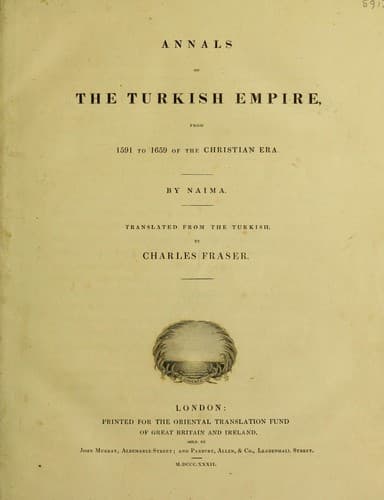
Annals of the Turkish Empire, from 1591 to 1659Naima, Mustafa
History
Annals of the Turkish Empire, from 1591 to 1659
Naima, Mustafa
Turkey -- History -- 1453-1683
Sinán Páshá was three times grand vezír, and commander-in-chief of
the troops which had been employed against Yanuk. When returning to
Constantinople he was ordered into exile; and Ferhád Páshá, who was
at that time káímakám, was created grand vezír a second time, and
also commander-in-chief. He was, however, deposed at the time he was
employed in erecting a bridge on the Danube when on his march to
Valachia, and was murdered in 1004. Sinán Páshá was again created grand
vezír in 1003. He went in great haste to chastise the rebel Michael,
but after having surmounted great difficulties in the mud, in which he
was very nearly lost, he returned in disgrace to Rusjuk. Lálá Mohammed
Páshá succeeded Sinán in 1004, but died ten days after his exaltation
to the premiership. Sinán Páshá succeeded a fifth time to the dignity
of grand vezír. It was he who had induced the late emperor to take a
personal share in the war with the infidels of the north. In Shabán
of that same year he took his journey into the eternal world. Sinán
was a native of Arnáúd, or Albania. He was, at the commencement of his
career, a cup-bearer in the court of Selím II., and became successively
military commander in the sanjáks of Malatiyeh, Kostamúní, Gaza, and
Tripoli. He was afterwards made beglerbeg of Erzerúm, then of Haleb,
and then again of Egypt. In consequence of some disturbance which had
taken place in Yemen he was sent thither, though in the seventy-seventh
year of his age, to quell it, which he did most successfully. He was
again sent to Egypt, but was recalled to Constantinople, where he at
once became vezír and head of the admiralty. In 980 he conquered Tunis,
and returned at the time Sultán Murád Khán mounted the throne, and
became one of his vezírs. In his eighty-eighth year he was appointed
to conduct the war against the Persians, and succeeded Ahmed Páshá in
the grand vezírship. In 994 he was governor of Syria. In 997 he was
again in the vezírship. In 999 he was deposed. In 1001 he was a third
time created grand vezír. In 1003-4 he was out, and again in the same
office. He was now very far advanced in age, being beyond ninety, when
he fell ill of a very severe cold he had caught, and died of it on the
5th of Shabán 1004, and was buried near Tevekil Cheshmeh (the fountain
of hope) in his own tomb. He was five times grand vezír and as often
commander-in-chief. One hundred orations were pronounced throughout the
empire in praise of this extraordinary man, who was considered third in
rank to Raslim Páshá and Mohammed Páshá of former days.
Public-domain text, read in full here on John Shaqi.
Reviews
Reviews
No reviews yet
Be the first to share your thoughts on this work.
Elsewhere in the archive
Join the Discussion
Join the discussion
Sign in to leave a comment or review.
Sign InorCreate an account