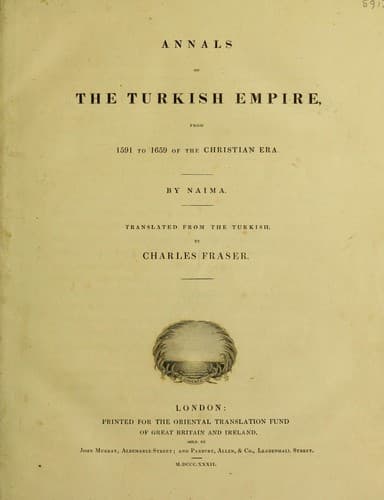
Annals of the Turkish Empire, from 1591 to 1659Naima, Mustafa
History
Annals of the Turkish Empire, from 1591 to 1659
Naima, Mustafa
Turkey -- History -- 1453-1683
After the sháh had accomplished the reduction of Reván, he led his
forces against Kars, and laid siege to it. The warriors of Kars, and
about four hundred Osmánlís, who had escaped thither from Reván, the
greater part of whom were wounded, were animated by such a spirit of
valour as vigorously to resist the invading host. The perverted sháh
was completely enraged; and sent them word, that when he took the place
he would not spare one of them.
Kurus, another place, but of less note, also fell into the hands of the
enemy, but the poor Musselmans who had escaped were surrounded by Gusah
Sefer Páshá, emír of Erzerúm. About this same time also, the enemy
attempted the taking of Akhiska, at least they manifested a disposition
to do so; but God protected it. Karah Kásh Páshá was, at that time,
hákim or governor of Akhiska, and was present in it when this hostile
disposition was manifested. Three hundred Persians, who had advanced
with full purpose of attacking the above place, took up their quarters
in a large dwelling not far from it, in which they gave themselves up
to most shameful actions. Thither they collected the females belonging
to the Armenian peasantry, and carried on with them the most obscene
courses. Their husbands, of course, were enraged at seeing their wives
thus used; and, therefore, secretly sent word to Sefer Sheríf Páshá;
who, without loss of time, attacked them with the few men who had
escaped from Reván. The mode of attack was rather singular: they made
a hole in the roof of the house wherein these voluptuous wretches had
taken up their quarters, and after they had fairly entered it, they
rose up and slew every one of these drunken revellers, who never once
dreamt of the destruction that awaited them. Their heads were severed
from their bodies and sent to Constantinople.
Sheríf Páshá, and also Karah Kásh Páshá, to whom we have been
referring, perished in a defeat which Jeghala Zádeh afterwards
sustained. It is said in the Fezliké, however, that the sháh, after he
had conquered Reván, shewed very great respect to Sheríf Páshá, and
conferred on him the superintendence of the mosques and other religious
establishments; and also that Sheríf Páshá spent the remainder of his
life at Meshhed. About four hundred families who had accepted of offers
which the sháh had made them, were all sent off to Kurus under the
charge of Mohammed Páshá, son of Khezer Páshá.
About this period, Sáa’tjí Hasan Páshá, the beglerbeg of Erzerúm, and
the commander-in-chief of the Turkish forces in the east, died, and
the troops became dispersed; but before we can attend further to the
relation of the affairs of the east, we have to commence the events of
the following year.
EVENTS OF THE YEAR 1013, H.
On the 20th of Moharrem, a tremendous earthquake, which happened at
Bassra, effected the demolition of the greater number of houses, both
inside and outside of the city, and under their ruins many thousand
individuals perished.
Public-domain text, read in full here on John Shaqi.
Reviews
Reviews
No reviews yet
Be the first to share your thoughts on this work.
Elsewhere in the archive
Join the Discussion
Join the discussion
Sign in to leave a comment or review.
Sign InorCreate an account