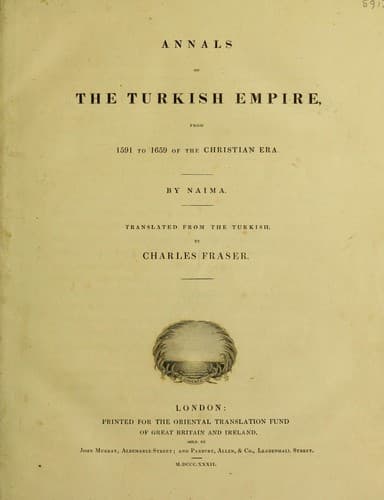
Annals of the Turkish Empire, from 1591 to 1659Naima, Mustafa
History
Annals of the Turkish Empire, from 1591 to 1659
Naima, Mustafa
Turkey -- History -- 1453-1683
The grand vezír, Alí Páshá, at length left Constantinople, and with
great pomp and show proceeded to Dávud Páshá, where his tent had been
erected for him. The grandees and nobles of every rank accompanied
the illustrious commander, and showed him every mark of esteem and
respect; and it is certainly true that no vezír ever met with more
honour from any emperor than did Alí Páshá from the reigning monarch.
On the fifth day of the above month his imperial majesty accompanied
the heroic army as far as Halkalú, where he took a view of them from
his lofty palace, and admired the splendid appearance they presented.
The grand vezír, on this occasion, requested his majesty to order the
funds necessary for conducting his army and carrying on the war to be
sent him; but whilst waiting at the above place for the anticipated
ducats, he received a most threatening royal letter, which intimated
to him in the plainest terms, that, if he wished to keep his head on
his shoulders, he must not delay his march one single day longer.
The grand vezír, compelled to activity, was making arrangements the
following day for complying with the threatening intimation which had
been sent him, when it began to be rumoured that the bostánjí báshí
had been sent by royal orders to call Háfiz Ahmed Páshá to court,
and that he was appointed by royal commission to the káímakámship of
Constantinople. Súfí Sinán Páshá, who had been appointed to this high
office by the grand vezír, as before observed, had actually entered on
the duties of the deputyship, and had done the customary obeisance to
the emperor after his appointment: such, indeed, was the fact. On the
Friday of that week, as Háfiz Ahmed Páshá was performing his devotions,
the royal commission appointing him to the deputyship of Constantinople
reached him. He accordingly without delay repaired to his own palace,
and ordered the diván to meet on the following day. He also sent his
saláms (compliments) to Súfí Sinán Páshá, and with the view of making
him acquainted with the change his majesty had thought proper to
make, desired him likewise to attend. Súfí Sinán, when he saw Háfiz’s
messenger, thought, at first, he was come from Alí Páshá, and asked him
if the grand vezír had sent him. “No,” said the officer, “it was Háfiz
Ahmed Páshá.” “Am I to understand by this message,” asked Súfí Sinán,
with some degree of surprise, “that Háfiz is appointed káímakám?” The
officer answered in the affirmative. Súfí Sinán, on having his doubts
solved, rose up and went to congratulate Háfiz on his appointment, as
if he had been altogether a neutral person, and in no way affected by
the change.
Public-domain text, read in full here on John Shaqi.
Reviews
Reviews
No reviews yet
Be the first to share your thoughts on this work.
Elsewhere in the archive
Join the Discussion
Join the discussion
Sign in to leave a comment or review.
Sign InorCreate an account