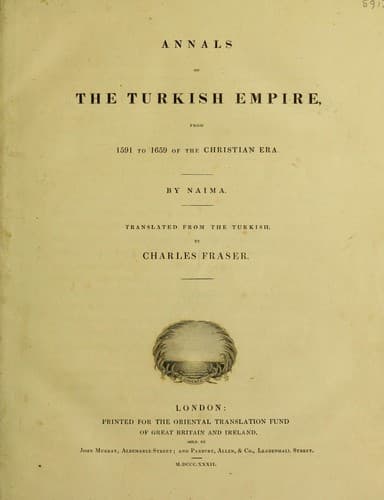
Annals of the Turkish Empire, from 1591 to 1659Naima, Mustafa
History
Annals of the Turkish Empire, from 1591 to 1659
Naima, Mustafa
Turkey -- History -- 1453-1683
The sháh, even after he had heard of the sudden departure of the
serdár, ceased not in his endeavours to reduce the city and fortress of
Wán for the space of forty days, but was at last obliged to raise the
siege, and then marched towards Tabríz and Nakhcheván. On this march,
however, he surrounded an Osmánlí place of strength called Makú; but
all he gained by laying siege to this fortress was only disgrace.
Before concluding this long section it is necessary to observe, in
connection with what we have related with regard to Jeghala Zádeh
Sinán Páshá, the commander-in-chief, that at the time the command of
the forces in the east devolved upon him, or at least not long after
it, Ja’fer Páshá was appointed lord high admiral in room of Jeghala;
and that he sailed for the Mediterranean with sixty galleys. In some
histories it is said, that it was the admiral Kehyah Páshá Zádeh
Mustafa Páshá who was appointed to the deputyship of Constantinople at
the time Alí Páshá and Jeghala Zádeh were made commanders-in-chief.
_Lálá Mohammed Páshá succeeds Alí Páshá in all his offices._
After the death of the grand vezír, Alí Páshá, which event had taken
place at Belgrade almost immediately after his arrival there, as we
have already noticed, a kapújí báshí of the name of Kúrd Mustafa
Páshá, brought accounts, in a sealed packet, to the government of
Constantinople that Alí Páshá was no more. The officer presented them
to the káímakám, Háfiz Páshá, who, however, declined receiving them.
Hereupon the emperor’s chaplain called the officer to the royal palace,
in order that it might be ascertained to whom it belonged to receive
the packet. He complained that Háfiz Páshá refused to have any thing
to do with the packet, though he knew it was an official despatch,
whilst at the same time it was evident that the forces employed against
the Hungarians were in the utmost need of having a commanding general
appointed over them. It would appear, however, that before the accounts
referred to had arrived, Lálá Mohammed Páshá had been raised by royal
appointment to the chief command of the army, but that the commission
had not reached him in sufficient time. He was now raised to the
dignity of grand vezír.
Lálá Mohammed Páshá no sooner found himself raised to the highest
offices which could be conferred on him, than he began with all
imaginable speed to make arrangements for renewing hostilities,
succeeded in taking several Hungarian towns, and afterwards returned
with the body of his army to Buda.
Having formed the design of recovering Osterghún, in order to secure
success as much as possible, he conferred on Bektásh Páshá, of Usk, the
jurisdiction of Buda, appointed him to the advanced guard, which was
composed of three thousand chosen men, and ordered him to march towards
the last-mentioned place.
_The infidels abandon Pest._
Public-domain text, read in full here on John Shaqi.
Reviews
Reviews
No reviews yet
Be the first to share your thoughts on this work.
Elsewhere in the archive
Join the Discussion
Join the discussion
Sign in to leave a comment or review.
Sign InorCreate an account