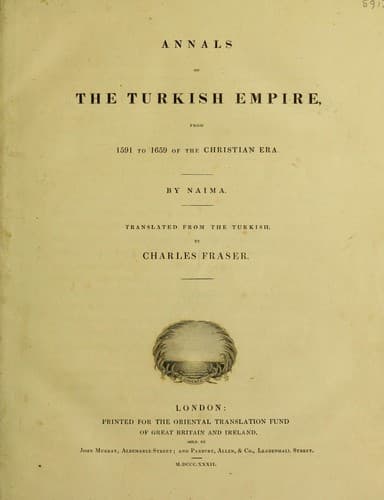
Annals of the Turkish Empire, from 1591 to 1659Naima, Mustafa
History
Annals of the Turkish Empire, from 1591 to 1659
Naima, Mustafa
Turkey -- History -- 1453-1683
The same historian observes, “that formerly, when Ibrahím Páshá was
commander-in-chief, the Tátárs, emírs, and other great men under his
command, had proposed to exchange Osterghún for Agria; because the
latter was much more distant from Buda than the former, and therefore
not of such importance to the Ottomans.” When Mohammed Ketkhodá, vezír
Murád Páshá, Ahmed Aghá, the khán’s vezír, and Hábel Effendí, the
cazí of Buda, went to the enemy’s camp, as the reader may remember,
with the view of endeavouring to negotiate a peace between the two
belligerent powers, the proposals above-mentioned were the principal
subjects submitted to the consideration of the negotiators; but no
settlement of any kind at that time was agreed to, and things remained
as they had been until this period, when the infidels began to show
a disposition favourable to a cessation of hostilities. Accordingly,
ten counts, ornamented with golden chains, and the great ministers of
state, arrived (probably at Belgrade), and gave their consent to the
propositions above alluded to, and Petcheví Ibrahím Effendí, whose
sentiments we are here quoting, was sent to the Sublime Porte as the
bearer of the propositions for a general pacification. Petcheví, on
arriving at Constantinople, presented his dispatches to the káímakám,
and to the reverend mufti, the venerable Siná-allah Effendí. Siná-allah
Effendí appeared greatly surprised at the nature and import of the
propositions which had been thus submitted; and exclaimed, “that they
were such as could never be agreed to; that they were altogether unfit
to be expressed in words; that they were unworthy of ever having been
thought of,” he therefore rejected them with scorn, and ordered the
officer who had brought them to retrace his steps, and deliver this
answer. The messenger obeyed, and met the commander-in-chief in the
plains of Serim; who having anticipated the result of his mission, and
without allowing him time to tell the message wherewith he was charged,
replied abruptly, “we must bear the disgrace;” and, immediately,
without any further reference to the subject, began to call the
messenger’s attention to the recent appearance of Botchkai, one of the
Transylvanian princes, to whose exploits our attention must now be
turned.
_Concerning Botchkai._
Public-domain text, read in full here on John Shaqi.
Reviews
Reviews
No reviews yet
Be the first to share your thoughts on this work.
Elsewhere in the archive
Join the Discussion
Join the discussion
Sign in to leave a comment or review.
Sign InorCreate an account