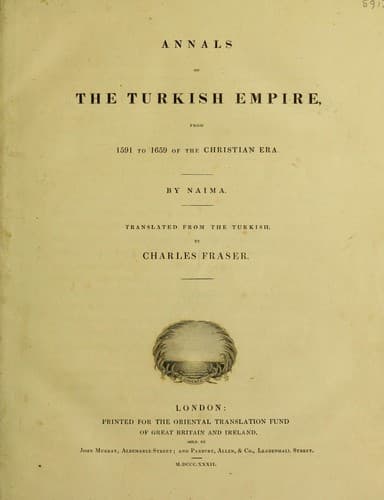
Annals of the Turkish Empire, from 1591 to 1659Naima, Mustafa
History
Annals of the Turkish Empire, from 1591 to 1659
Naima, Mustafa
Turkey -- History -- 1453-1683
Towards the end of Jemadi II. a messenger arrived from Egypt, bringing
to the court of Constantinople the sad intelligence that the Egyptian
troops had murdered Hájí Ibrahím Páshá. The eunuch, Gúrjí Mohammed
Páshá, who had lately been raised to the rank of _third_ vezír, was
appointed válí of Egypt in the room of the deceased. The galley in
which the new válí had embarked reached the port of Alexandria in one
week’s time; and after having entered upon the government of Egypt, he
put to death every individual of those who had been in any way involved
in the tumult in which his predecessor had perished. By force of arms
he established peace throughout the whole of his jurisdiction, attended
to the state of the finances, and inspired all ranks with terror.
On the 25th of Rajab the válí of Romeili, Hasan Páshá, was advanced
to the rank of fourth vezír; Hasan Aghá, the brother of Tarnákjí
Páshá, was, in the same month, made commander of the janissaries. The
government of Algiers was conferred on Mustafa Aghá, who had been chief
of the eunuchs in the days of Selím II.
_Sárukjí Mustafa Páshá is murdered.—Súfí Sinán succeeds him._
It was not very long after Sárukjí Mustafa Páshá had entered on the
duties of his office as deputy of Constantinople, when some violence
began to be manifested by the troops on account of the pay which was
due to them. Whilst the lord high treasurer, Mohammed Páshá, son of
Músá Chelebí, was straining every nerve to meet the demands of the
military, some of his enemies had an interview with the emperor’s
chaplain, who lodged accusations with his excellency the deputy against
him. The deputy, not perceiving the evil that was soon to happen to
himself, deposed him and appointed one Háfiz Mahmúd to succeed him; a
man who was every way unfit for so high and important a situation as
that of chief treasurer, and one, too, whom the emperor abhorred. The
deputy’s infatuation did not stop here; he endeavoured, with all his
might, to get Siná-allah Effendí, the reverend mufti, removed from
his spiritual jurisdiction, and to place Mohammed Effendí, the eldest
son of Khojeh, in his stead. The reverend mufti no sooner received
intelligence of the deputy’s manœuvres, than he immediately entered,
with the emperor’s chaplain, into a conspiracy against the life of
Sárukjí Páshá. They used every means they could think of to blacken
his character in the opinion of the emperor, and succeeded but too
well in exciting his displeasure against him. One day, as he went on
some business connected with his office to the royal palace, he was
desired to wait on his majesty; but on his retiring he was seized, an
executioner was called, and in an instant his head was cut off. His
body was thrown into a well in the court of the diván,[14] and Súfí
Sinán Páshá was appointed káímakám in his stead.
Public-domain text, read in full here on John Shaqi.
Reviews
Reviews
No reviews yet
Be the first to share your thoughts on this work.
Elsewhere in the archive
Join the Discussion
Join the discussion
Sign in to leave a comment or review.
Sign InorCreate an account