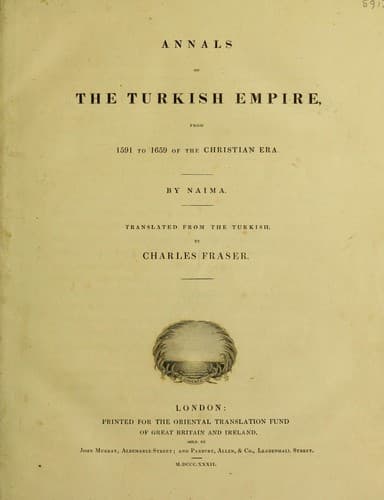
Annals of the Turkish Empire, from 1591 to 1659Naima, Mustafa
History
Annals of the Turkish Empire, from 1591 to 1659
Naima, Mustafa
Turkey -- History -- 1453-1683
It having been considered of the last importance to ascertain the
actual state of the Hungarian frontiers, Mohammed Páshá was granted
full power over the troops, and to employ them in any way he thought
proper. It was also the emperor’s declared determination and wish that
Osterghún should be reconquered from the enemy if possible. With this
view Hasan Aghá, Tarnákjí’s brother, and ághá of the janissaries, was
appointed to proceed with a large body of janissaries to Belgrade,
and afterwards join the commander-in-chief at Buda. This body of
troops left Constantinople on the 27th of Dhu’l hijja, and halted at
Dávud Páshá for the purpose of making some further arrangements for
the journey. Abdul Bákí Effendí was appointed treasurer to the army;
Etmekjí Zádeh had been sent to Romeili to collect the taxes; Súfí Sinán
Páshá having been in full power, and deputy of the Sublime Porte, sent
Dávud Páshá to command the garrison of Kostamúní; and Nesúh Páshá
was made commander in Anatolia, and appointed to protect the Ottoman
boundaries in that quarter.
Hasan Aghá, after having remained a week at Dávud Páshá, recommenced
his march towards Belgrade, which place he reached about the latter
end of the month Sefer. Having refreshed his troops and attended to
the other necessary preparations for prosecuting his march to Buda, he
left Belgrade and passed the plains of Zimún for that fortress on the
4th of Rabia II. The whole army assembled at Usk, where a council of
war was held. The commander-in-chief proposed for the consultation of
the counsellors, what measure ought first to be adopted for securing
the desired success? The borderers and several of the chiefs of the
army thought it was by all means most advisable to proceed directly
to Buda and Alba Julia, and check the progress of the enemy in those
quarters, or at least protect them against any assault which the enemy
might threaten. Information had already arrived, they said, which
fully announced the threatening aspect the enemy was assuming with
regard to both these places. The enemy, they were aware, was making
every preparation in Komran for renewing hostilities, and already had
acquired some success. It was their imperative duty, continued the
speakers, to march immediately to Buda and Alba Julia, and protect
these places against the enemy of their country and of their faith.
Such were the arguments employed on one side of the question. Others,
however, opposed them, and argued differently. They, in the weakness
of their judgment, maintained that Buda and Alba Julia were places
of strength, and well furnished with the means of self-defence; so
much so, indeed, they said, that the enemy had given up all hope of
succeeding against them. These two places, the objects of so much
concern and anxiety, therefore, might very well, and without any
danger, they maintained, be left to their own resources. But there is
Mekamúriah, said these trifling advocates. It presented a fine field
Public-domain text, read in full here on John Shaqi.
Reviews
Reviews
No reviews yet
Be the first to share your thoughts on this work.
Elsewhere in the archive
Join the Discussion
Join the discussion
Sign in to leave a comment or review.
Sign InorCreate an account