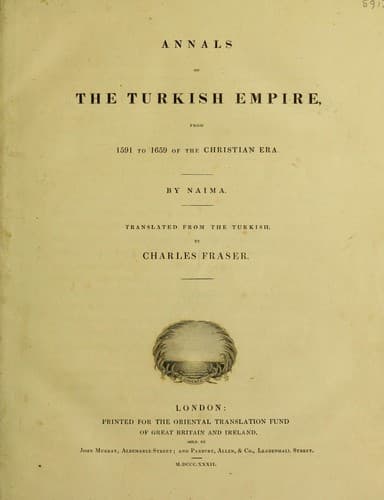
Annals of the Turkish Empire, from 1591 to 1659 — John Shaqi
Annals of the Turkish Empire, from 1591 to 1659Naima, Mustafa
History
Annals of the Turkish Empire, from 1591 to 1659
Naima, Mustafa
Turkey -- History -- 1453-1683
religious purpose, in Constantinople, where he died in the month of
Ramazán, in the year 1001 of the Hijrah. Khalíl Páshá was son-in-law to
the emperor. Hazár Páshá was Válí of Egypt. Ja’fer Páshá was son-in-law
to Mohammed Páshá. He was an excellent vezír: he died lamented in 995.
Hasan Páshá, the eunuch, was a potent and brave man: he was a native of
Shirván, but was raised to the office of grand vezír. Vezír Alí Páshá
married the widow of Mohammed Páshá, and died in office. Mohammed Páshá
was murdered whilst governor of Romeili. Vezír Yúsuf Páshá was by birth
an European, but of noble descent. He died a martyr in the arms of his
domestics in his own palace near Kirk Cheshmeh. Vezír Shemshí Páshá was
a Persian: he died in 989. Vezír Hasan Páshá was joint governor in the
government of Romeili with Mohammed Páshá, who was the son of Sinán
Páshá, grand vezír at the death of Murád Khán. Between Hasan Páshá and
Mohammed Páshá, who were both in active service under Sinán Páshá, in
the late war in Hungary, existed no small degree of envy.
_Learned Men contemporary with Sultán Murád Khán._
Hamid Effendí was mufti when Murád ascended the throne, and died
three years afterwards. Khoja Saadín Effendí was tutor to the emperor
when he resided in his Sanjak. After his elevation to the throne,
Saadín Effendí became his counsellor in what concerned the well-being
of the state and in the art of government. Cazi Zádeh Effendí was a
mufti who wrote a comment on the law, and was a guide to salvation.
Malúl Zádeh Effendí was military judge in Romeili and succeeded Cazi
Zádeh as mufti. In consequence of having failed to show some acts of
politeness to the emperor’s adviser and spiritual counsellor, Khoja
Hasan Ján Zádeh Saadín, and for some mistakes which he had committed,
he was represented to the emperor, and deposed. He died in 992. Tchoí
Zádeh Effendí was an interpreter of the law, and his decrees were
esteemed more excellent than any of those of his contemporaries. He
succeeded Malúl Zádeh as the mufti. He was a remover of oppression and
injustice. He died in 995. His son, Shúkhjí Effendí succeeded him in
the high priesthood, but was afterwards deposed. Bostán Zádeh Effendí
is well known. Zekeriáh Effendí is the most honourable of all the
interpreters of the law. On going into the imperial palace one day to
receive a robe of honour from his majesty Sultán Murád Khán, he was
seized with fainting fits, in one of which he died, 1001. Abdur-rahmán
was contemporary with Sultán Soleimán and Sultán Selím, and was one
of the military judges of those times in which they lived. He died in
Rabia II. 983. Násir Zádeh Effendí died suddenly in 984, whilst Cazi
of Constantinople. Ahkí Zádeh Effendí retired from his jurisdiction in
Anatolia with a salary of 150 akchas. He died in 989. Bokhárí Zádeh
Effendí was deposed from his jurisdiction in Tripoli, in Syria, and
died in 986. Mehshi Sinán Effendí retired with a salary of 200 akchas
Public-domain text, read in full here on John Shaqi.
Reviews
Reviews
No reviews yet
Be the first to share your thoughts on this work.
Join the Discussion
Join the discussion
Sign in to leave a comment or review.
Sign InorCreate an account