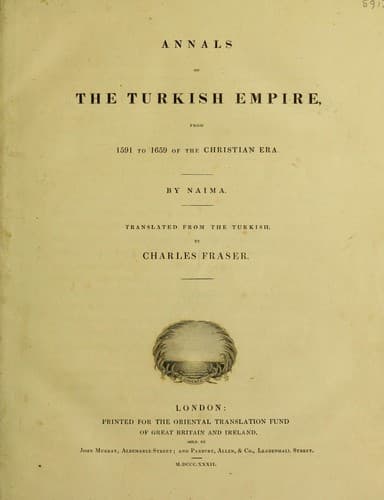
Annals of the Turkish Empire, from 1591 to 1659Naima, Mustafa
History
Annals of the Turkish Empire, from 1591 to 1659
Naima, Mustafa
Turkey -- History -- 1453-1683
from his office, as military judge, in Anatolia, and died in 982.
Neshánjí Zádeh Effendí was deposed from his jurisdiction in Medina.
Hemshíreh Zádeh Effendí died when he was lecturer in Sultán Selím’s
academy, _i.e._ in 989. Sinán Zádeh Effendí died in 987. Kamí Ahmed
Effendí died in the same year. Mualim Zádeh Mahmúd Effendí was raised
from the academy of Sœhen to the office of recorder or chancellor.
He was afterwards deposed, and died in 987, Bábá Effendí was tutor
to Rustem Páshá. He was a pious and religious man. Sárí Kiris Zádeh
Effendí died when he was Cazi of Haleb, in 987. Abdul Vafá Effendí
was the son of Abú Saoúd. Ezumí Effendí was tutor to one of the royal
princes. He died in 999. Hazár Beg Chelebí died in the academy attached
to the convent of Brúsa. Khosrú Zádeh Mustafa Effendí was a man of
various attainments, and an orthodox guide in religion. In 998 he
was Cazi of Tripoli in Syria, where he caught a severe cold. He died
at Aksheher, on his way to Turkey, in 1000. He was a well-informed,
gentle, and humane man. He made a collection of all the vulgar
errors, and translated the History of Kútb Mekí, and left several
fine poems in Turkish. Vankúli Mohammed Effendí was a man of the most
consummate skill and learning. From the academy of Sœhen he was
raised to be Cazi of Magnesia. He held the same office, successively,
in Thessalonia, in Kutahiah, and in Anatolia, and was afterwards
raised to the chief Caziship in Medina. He retired from office with a
salary of eighty akchés, and died in the latter city, in 1000. To his
extensive information he added that of undaunted firmness, and was a
perfect linguist. He wrote several pious epistles and translated the
_Seháh Júherí_, which was deposited in the mosque of Sultán Mohammed
Khán. He also translated the _Kimiái Sa’ádet_. Abdul Káder Effendí,
son of Emír Gísúdárí, and known by the name of Yálánjek Effendí, was
judge of Kutahiah, and afterwards held the same office in Tripoli.
It was not with his will that he was restrained from denouncing the
great men of his day; for which, in fact, he was at last banished the
city. He was a man of great violence and excessive virulence. It is
said in the _Zeíli Shukáïk_, that his composition is weak, and his
sentiments incorrect. He was some time Cazi of Yení Sheher, but was
degraded, and died in 1000. Mevlana Mohammed Aydin of Akhisar was some
time Cazi in Egypt, and was afterwards chief-priest in Medina. He was
a clever, excellent, and acute man. His poems were extant in the year
1003. There is also a translated compendium of his writings. He died
in the year 1000, in Medina. Ismáíl Effendí was a complete separatist,
and subsisted by teaching. He resembled a dervish: but having been
a well-informed man, he wrote a commentary or paraphrase on the
_Mesnevi_, the _Diván of Háfiz_, the _Gulistán_, and the _Bostán_, in
Turkish. He died in 1000. Sevdí Effendí was a native of Bosnia. He was
a person of great learning.
Public-domain text, read in full here on John Shaqi.
Reviews
Reviews
No reviews yet
Be the first to share your thoughts on this work.
Join the Discussion
Join the discussion
Sign in to leave a comment or review.
Sign InorCreate an account