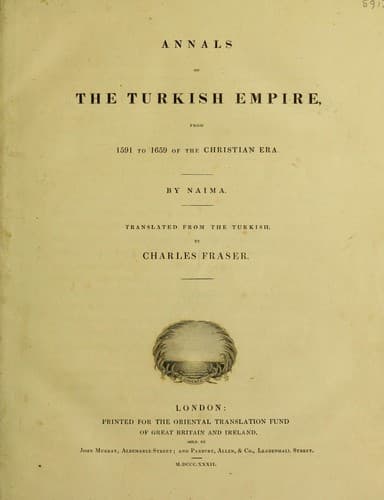
Annals of the Turkish Empire, from 1591 to 1659Naima, Mustafa
History
Annals of the Turkish Empire, from 1591 to 1659
Naima, Mustafa
Turkey -- History -- 1453-1683
The lamented emperor was a man of very extraordinary attainments. Owing
to his wisdom and prudence, all parts of the empire felt, during his
whole reign, the benefit of his solicitude and care, of his military
skill and heroic bravery, both in governing the empire and in vexing
and punishing the enemies of religion and of the state. In consequence
of no impediment having been thrown in the way of the learned men and
poets of that day, they have favoured the world with a sober account of
his life, which is contained and set forth in a book of contemplation
called the Fatúhát Síám (فتوحات صيام), in which is introduced Arabic,
Persian, and Turkish poetry.
During the time the royal prince remained in Magnesia, the late emperor
caused a noble mosque of two minarets, a school, and other religious
establishments to be erected there, besides an inn and conservatory. He
caused also the roof of the temple of Mecca to be supported by pillars,
a canal to be made, and an edifice, where religious rites might be
performed, to be erected. He transmitted many thousands of ducats to
that city of religious fame. At Bektásh, over the grave of Yahiah
Effendí, he caused a splendid arch to be raised to his memory.
_Vezírs contemporary with Sultán Murád Khán._
Mohammed Páshá, who had continued in possession of the premiership
ever since the days of Soleimán, was murdered in a scuffle with a
furious mad fellow in the diván. He was succeeded in office by Ahmed
Páshá, who died about four months after entering upon his duties in
the grand vezírship. Lálá Mustafa Páshá, the conqueror of Cyprus and
Shirván, died when he was governor of the Sublime Porte. Khoja Sinán
Páshá, the conqueror of Yanuk, was his successor, and he was succeeded
by Zál Mahmúd Páshá, who was proprietor of the temple called Zál
Páshá in the neighbourhood of Ayúb-Ensári. He died in office. Vezír
Hasan Páshá was also carried off by death. Síávush Páshá was Káímakám
once, and three times grand vezír, but died without any office. Osmán
Páshá, son of Timúr Páshá, one of the ancient heroes, was during his
premiership commander-in-chief in the Persian war. He reduced Tabríz,
and afterwards fell sick and died. Mesíh Páshá succeeded Osmán, but
died out of office. Ferhád Páshá was twice commander-in-chief in the
east, and for having afterwards effected an advantageous peace, was
created grand vezír. He was Káímakám, or governor of Constantinople,
when Sultán Murád Khán died, as we have already seen. Ibrahím Páshá was
son-in-law to the emperor. Vezír Jeráh Páshá is well known. Jaghala,
son of Sinán Páshá, was both vezír and admiral at the same time. Boyálí
Mohammed Páshá, son of Pír Ahmed: he died after he was deposed from
the beglerbegship of Haleb. He was successively Remembrancer, Reïs
Effendí, Chancellor and Válí of Haleb, and twice in the privy council.
He was a man of very extensive information and experience. He built a
handsome mosque, a school-house, and another edifice dedicated to a
Public-domain text, read in full here on John Shaqi.
Reviews
Reviews
No reviews yet
Be the first to share your thoughts on this work.
Join the Discussion
Join the discussion
Sign in to leave a comment or review.
Sign InorCreate an account