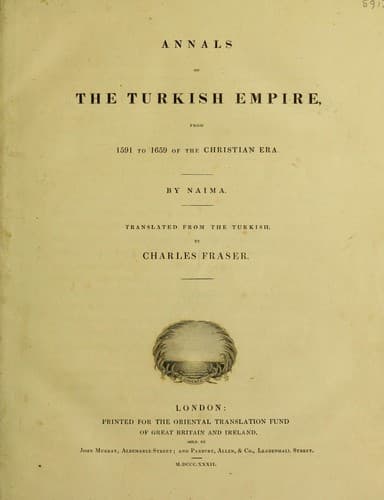
Annals of the Turkish Empire, from 1591 to 1659Naima, Mustafa
History
Annals of the Turkish Empire, from 1591 to 1659
Naima, Mustafa
Turkey -- History -- 1453-1683
Sheikh Yolluk Mohammed Chelebí was preacher in the mosque of Sultán
Mohammed, and taught theology. Sheikh Mohammed Effendí was an
illustrious preacher in St. Sophia, and, in fact, a brave fearless
man. He was the cause of serious difficulties to Sheikh Emír Effendí,
who was preacher in the Soleimáníyeh. Sheikh Khezr Effendí was the son
of a chief of a cohort of Janissaries, and a pious chaste preacher
and a good speaker. Sheikh Tátár Ibrahím Effendí was a practical man
and a historian: he explained and taught extempore in the mosque of
Sultán Mohammed. Sheikh Shabán Effendí was a painter. He perfected
himself in Emír Bokhárí’s convent, and chose the life of a Dervísh. His
imperial majesty was in the habit of paying him visits. Sheikh Kúrd
Effendí was a very able expositor. Sheikh Hasan Effendí officiated in
the mosque of Khoja Mustafa Páshá. Sheikh Mohammed Effendí, after the
death of Bábá Effendí, by the recommendation of Siná Allah, military
judge of Romeili, was appointed to the mosque of Sultán Mohammed, by
Ferhád Páshá. He captivated, by his lofty eloquence, the heart and
the affections of the great, and secured the respect of the emperor’s
tutor and his family. These things caused his patron, Siná Allah, to
regret his having recommended him. Jaghala Zádeh and other vezírs
were assiduous in attending the assemblies on Thursdays and Fridays
to hear his orations. In short, so great was his fame, that even the
emperor and the great men of the state were included in the number
of his hearers, which increased every day. The wife of Rustem Páshá
built for him a mosque and a small meeting-house, when of course
he ceased preaching any more in Sultán Mohammed’s mosque. Sheikh
Abú-vafá was employed by the Khalifs in many cities for the purpose
of extending religion. He was in great favour with the late lamented
emperor Murád-khán when he was in Magnesia. In consequence of his great
fame he was called from that city, after Murád’s inauguration, to
Constantinople, put in possession of a splendid mansion, and allowed a
suitable salary. He was generally known by the appellation _Pádisháh
Sheikhí_ (the emperor’s spiritual guide). He had a great deal in his
power, being keeper, as it were, of the emperor’s conscience; and it
was, therefore, an easy thing to secure offices of trust and importance
for those who found access to him. In a certain sense he was a sort of
asylum to the members of the diván. Doubtless those who had posts, and
who were deprived of them, found it their interest to wait upon his
eminence, and show him the respect due to him. He died in 998.
_Facts relative to the new Emperor Sultán Mohammed Khán III._
Public-domain text, read in full here on John Shaqi.
Reviews
Reviews
No reviews yet
Be the first to share your thoughts on this work.
Join the Discussion
Join the discussion
Sign in to leave a comment or review.
Sign InorCreate an account