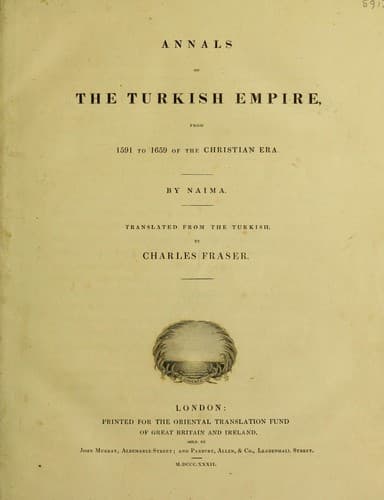
Annals of the Turkish Empire, from 1591 to 1659Naima, Mustafa
History
Annals of the Turkish Empire, from 1591 to 1659
Naima, Mustafa
Turkey -- History -- 1453-1683
The grand vezír, Ferhád Páshá, reached Rusjuk towards the end of
Shevál, and immediately commenced preparations for erecting a
bridge across the Danube. Artificers, brought from Nicopolis, were
set to the work. From some prisoners who had been brought to the
commander-in-chief he learned that the wicked and mischievous Michael
had received a reinforcement, from Transylvania and Hungary, of
about 70,000 troops, and that he was posted at Bekrish. About the
commencement of Dhu’l Kadah, the Beglerbeg of Romeili, Hasan Páshá,
joined the royal camp with four thousand troops, and brought along with
him five hundred Valachian and Hungarian prisoners. The grand vezír
and commander-in-chief, Ferhád Páshá, sat under a canopy supported by
eight pillars, and superintended the erections which were carried on.
The whole might have been completed in five or six days had it not
been found necessary to extend the bridge to an island in the river,
opposite Yerkok. To accomplish this object, the Sanjak chiefs were
ordered to cut down trees suitable for the purpose, and to transport
them to the spot where they were needed. Whilst these erections were
going forward, arrangements were also made to pay four divisions of
troops which remained in the garrison of Belgrade; the Serdár himself
intending, after he had chastised the rebel Michael, to remove to that
city.
_Ferhád is deposed.—Sinán Páshá raised to the Premiership._
It has already been observed how Ibrahím Páshá, the son-in-law of Sinán
Páshá, and other sycophants of the latter, had effected a change in the
emperor’s mind towards Ferhád. They at last succeeded in moving him to
remove him from office altogether. Accordingly the seals of office,
at the close of the month Shevál, were sent to Sinán Páshá, who, on
being raised to the premiership, set immediately to work in seeking the
destruction of his predecessor. He insinuated that Ferhád maintained
a secret correspondence with the apostate Michael: that he meditated
the utter ruin and destruction of the Moslem army: he accused him of
negligence, infidelity, and treachery, and importuned his warrant: and,
in order to encompass his death, he took the royal seal and signed
a commission, which he sent to the deputy of the Janissaries, Ahmed
Aghá, desiring him to execute this diabolical but earnestly desired
object. He issued another order for taking possession of the arsenal
and other stores which Ferhád had provided for the war. Before either
of these firmáns reached the place of their destination, however, a
friend of Ferhád had hastened, with all manner of speed, to inform him
what was going on against him. The information had such an effect on
the unfortunate Páshá, that his life, for a while, was despaired of.
He was, however, able to make arrangements for his return. He informed
a diván, called for the purpose, that he found it necessary to return
to Constantinople, and therefore required some men to accompany him.
Public-domain text, read in full here on John Shaqi.
Reviews
Reviews
No reviews yet
Be the first to share your thoughts on this work.
Elsewhere in the archive
Join the Discussion
Join the discussion
Sign in to leave a comment or review.
Sign InorCreate an account