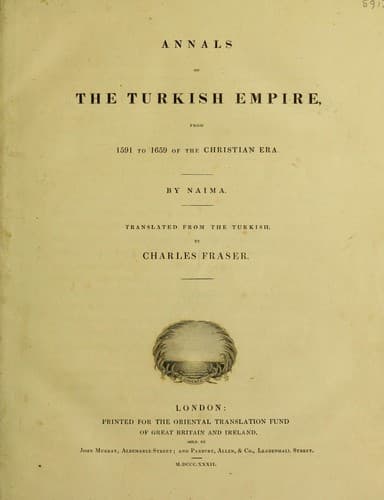
Annals of the Turkish Empire, from 1591 to 1659Naima, Mustafa
History
Annals of the Turkish Empire, from 1591 to 1659
Naima, Mustafa
Turkey -- History -- 1453-1683
He, accordingly, selected about three thousand veterans from the
most valiant of the troops, and delivered over, secretly however, to
Satúrjí Mohammed Páshá, his own seal, and all the stores to Mohammed
Páshá. Having settled every thing relative to the troops that were to
accompany him, he mounted his horse and set out for Constantinople. To
avoid meeting the officer who had in charge the grand vezír’s firmán,
he travelled by a different route, night and day, with the greatest
speed.
When the officer reached Rusjuk, he learned, to his surprise, that
Ferhád had set out two days before; but with the assistance of
Satúrjí Mohammed Páshá, he immediately transmitted an account of this
circumstance to Constantinople.
Sinán Páshá was still in the metropolis. The Syrian troops, destined
for the war, had arrived. Sinán informed them that a sentence of death
had been issued against Ferhád. “His head is mine, his property yours,”
said he, and sent off these fearless troops to intercept him.
In the mean time Sinán Páshá busied himself in making arrangements for
carrying on the war in Hungary. The Syrian troops, just now mentioned,
fell in with Ferhád’s treasures, which were carried on camels. These
they seized, whilst Ferhád himself stood on a rising ground at a
distance, and saw what was going on. There is another version of this
story. It says, that when these Syrians met Ferhád, he had the presence
of mind to scatter some purses of silver and gold amongst the rapacious
fellows, and made off with himself whilst they were scrambling for
the booty thus thrown amongst them. The story goes on to say that the
Syrians began to quarrel about the division of the spoil they had so
very easily acquired, and that instead of fairly dividing it, each man
set off with what fell into his own hands.
Ferhád, in the meantime, succeeded in descending the mountains of
Istrenj, and arrived at his own villa near Constantinople in the middle
of Dhu’l hijja. Here he concealed himself, but sent all his treasures
and jewels as a present to the emperor’s mother. This mode of applying
his money had a wonderful effect, for the joyful news of his being
about to be pardoned soon became public.
Public-domain text, read in full here on John Shaqi.
Reviews
Reviews
No reviews yet
Be the first to share your thoughts on this work.
Elsewhere in the archive
Join the Discussion
Join the discussion
Sign in to leave a comment or review.
Sign InorCreate an account