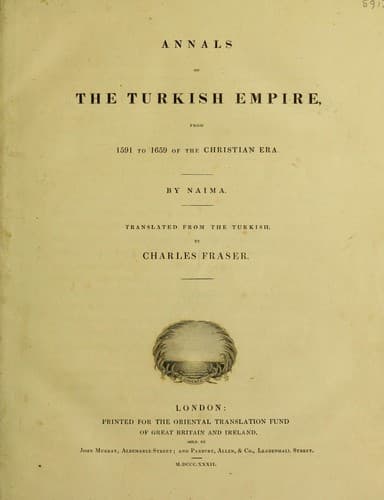
Annals of the Turkish Empire, from 1591 to 1659Naima, Mustafa
History
Annals of the Turkish Empire, from 1591 to 1659
Naima, Mustafa
Turkey -- History -- 1453-1683
The grand vezír, Sinán Páshá, reached Rusjuk, on the borders of the
empire, before these things had transpired, and had other objects
to occupy his attention, independent of Ferhád. But his son-in-law,
Ibrahím Páshá, was still governor of Constantinople, and when he heard
the report that Ferhád was to be pardoned, formed another plot for
effecting his destruction, which succeeded, as the sequel will show. He
employed one Soleimán, a German Jew, a well-known fellow, who succeeded
in finding out where Ferhád had secreted himself, and afterwards sent
him (probably by the same infamous Jew) a letter, as from the emperor,
which conveyed to him a free pardon. This, the poor man had no
doubt, was an act of mercy from his sovereign, and therefore ventured
out of his hiding-place and commenced paying visits to his friends.
One morning, however, by break of day, his villa was surrounded,
and himself made prisoner by the Bostánjí báshí, who conducted him
forthwith to the Seven Towers. This took place on the 5th of Sefer,
1004. Ibrahím Páshá wrote out his indictment and laid it before the
throne, and soon afterwards succeeded in obtaining the emperor’s
warrant for taking away his life. Accordingly, Chobán Soleimán Aghá,
a chávush báshí, strangled him in the Seven Towers that same night,
before supper-time.
_A Reflection._
The late Ferhád Páshá was a man who had rendered many important
services to his country whilst employed in the Persian war, and was
one of those who had forwarded the elevation of the then reigning
monarch; but he was rewarded, as we have seen, with disgrace heaped
upon him, and, at last, with an ignominious death. The late emperor
knew his value, and always showed him peculiar honour and respect.
Sultán Mohammed Khán was a man who was free from guile and duplicity,
and unacquainted with cunning and deceit; but he had not reached that
degree of penetration which so much distinguished his father, and
which would have secured him from putting too much confidence in his
advisers, and have kept him from committing himself before he had made
proper and strict inquiry. The result of the want of these qualities we
have seen.
_Sinán Páshá’s Operations in Valachia._
Public-domain text, read in full here on John Shaqi.
Reviews
Reviews
No reviews yet
Be the first to share your thoughts on this work.
Elsewhere in the archive
Join the Discussion
Join the discussion
Sign in to leave a comment or review.
Sign InorCreate an account