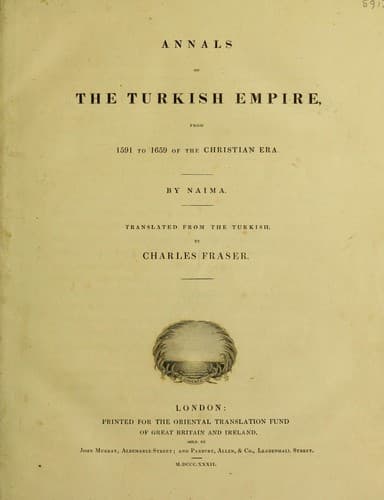
Annals of the Turkish Empire, from 1591 to 1659Naima, Mustafa
History
Annals of the Turkish Empire, from 1591 to 1659
Naima, Mustafa
Turkey -- History -- 1453-1683
About this time Osmán Páshá, beglerbeg of Yanuk, sent information
that the Austrians were preparing to send a large army; and it so
happened that, towards the end of Dhu’l Kada, an army of 50,000
foot and 20,000 horse laid siege to Osterghún. The Moslem serdár, or
commander-in-chief, and the other beglerbegs, could muster no more than
10,000, and therefore prudently forbore attempting to offer battle to
so immense a host. They accordingly took up their position on a hill
opposite the enemy, and there meant to wait till they received more
succour.
_The Moslem Army advances to Osterghún, and are defeated._
About the commencement of the month Dhu’l hijja, the
commander-in-chief, Sinán’s son, the beglerbeg of Buda; Súfí Sinán
Páshá, the beglerbeg of Temisvar; Mikaeljelí Ahmed Páshá, the beglerbeg
of Scutari; Teríakí Hasan Páshá, the beglerbeg of Haleb; Mohammed
Páshá, and the beglerbeg of Yanuk, Osmán Páshá, advanced with the
10,000 lately mentioned to Osterghún, and took up their position
immediately opposite the enemy. This was a fool-hardy step, and one
for which they paid dearly: for that very day the battle commenced,
and was continued for several days, when it ended in the discomfiture
of the Moslem army, as might have been easily anticipated, considering
the vast majority of the enemy. The following day, when the Moslems
advanced to the conflict, they were encircled by a considerable body
of the enemy, drawn up in regular order to receive them, but whom
the Moslems, led on by Osmán Páshá, drove back, retaking at the same
time Jegirdilen, a place of some strength, and spiked the whole of
the cannon in it. Hitherto fortune seemed to declare for the orthodox
army, but on the fourth day it experienced a reverse. In approaching
Dipadilen, another place of strength, the Moslems were much annoyed by
the small arms of the enemy, which played incessantly upon them. Here
many of the brave Musselmans fell lifeless on the ground, and among
them was Osmán Páshá. Another division of the Moslem army attacked
the enemy’s trenches on the Danube, and got possession of them. Here
they either slew or drowned in the river such of the enemy as fell
into their hands: but alas! this act of heroism was dearly paid
for; for on retiring from these trenches they were met by a strong
augmentation of the enemy coming forward to the aid of those who had
been in the trenches, when a most desperate and awful conflict ensued.
The Serdár, thinking his Moslems were overpowered, turned his face
towards Buda and set off. Others, seeing this, followed his example.
Teríákí Hasan Páshá was no sooner made aware of the state of matters
than he too ordered his tents to be struck, loaded his waggons with
the heaviest of his baggage, caused oxen to be put to them and to his
field-pieces—which had been kept as memorials of Soleimán—and moved off
for Buda, whither the rest had fled.
Public-domain text, read in full here on John Shaqi.
Reviews
Reviews
No reviews yet
Be the first to share your thoughts on this work.
Elsewhere in the archive
Join the Discussion
Join the discussion
Sign in to leave a comment or review.
Sign InorCreate an account