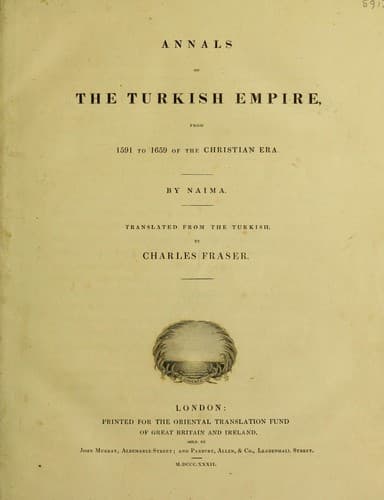
Annals of the Turkish Empire, from 1591 to 1659Naima, Mustafa
History
Annals of the Turkish Empire, from 1591 to 1659
Naima, Mustafa
Turkey -- History -- 1453-1683
The grand vezír had scarcely reached the very first stage, however,
before the atrocious Michael started out of the woods and surrounded
Terghúshta with his troops. The sound of his cannon was distinctly
heard in the grand vezír’s camp. After three days of violent effort he
took the place. Alí Páshá, Khoja Beg, and other persons of distinction,
he caused to be fixed on spits and roasted before a fire: the rest of
the garrison he made prisoners, set fire to the place, and withdrew.
Information of this disaster reached the grand vezír the day it took
place, and awakened the grief and sympathy of the whole army. Whilst
they stood deploring the fate of the garrison, and of their brethren
who had fallen into the hands of their merciless enemies, three
hundred of these infidels issued out of the wood, not very distant
from the Moslem camp, but they were all dispersed by a party of the
Romeilian troops. The army now began to retrace their steps. After
consulting as to the propriety of returning to Terghúshta, about which
there existed a variety of opinion, they at last resolved on going to
Bekrish, which they accordingly did. During fifteen days which the
army was ordered to remain there, all the traders, whether belonging
to the army or otherwise, were requested to remove in that space of
time with their effects out of Bekrish, and retire to some other place
of greater security. After this and other matters of importance were
fully attended to, the guns and other stores belonging to this garrison
were put on waggons and removed, and itself, so lately built, set fire
to about midnight, when the troops left it to perish. After hastily
passing through the pass of Bekrish they arrived at Yerkok, where they
halted three days.
On reaching this place, the grand vezír was confounded when he
perceived that the bridge, which had been confided to a sufficient
guard, across which ten thousand waggons and captives had passed, was
now watched only by five. Formerly, the Moslem troops were in the habit
of making excursions by this bridge into the country of Transylvania,
and returning by the same with waggons loaded with spoil, thousands of
captives, and with droves of cattle, sheep, and young horses, and which
used to be sold in the Moslem camp. Here also a faithful custom-house
officer used to sit and collect an impost which was levied on all such
imports.
Public-domain text, read in full here on John Shaqi.
Reviews
Reviews
No reviews yet
Be the first to share your thoughts on this work.
Elsewhere in the archive
Join the Discussion
Join the discussion
Sign in to leave a comment or review.
Sign InorCreate an account