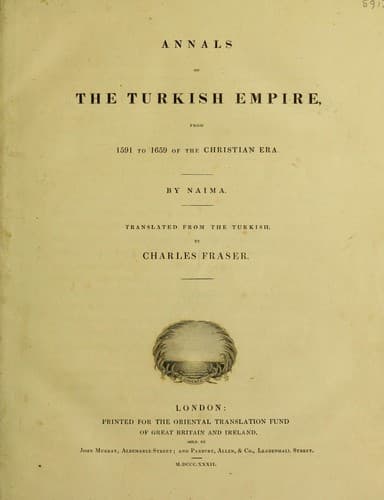
Annals of the Turkish Empire, from 1591 to 1659Naima, Mustafa
History
Annals of the Turkish Empire, from 1591 to 1659
Naima, Mustafa
Turkey -- History -- 1453-1683
After the two hostile armies were once confronted, Sinán Páshá,
belonging to the Cherkess (Circassian), Fateh Gheráí and Murád Páshá,
the Beglerbeg of Diárbeker, besides some other valiant and heroic
chiefs, rode forth in front on their prancing horses, and giving the
cry of war, rushed forward, sword in hand, to the bloody conflict
and to death. They were, however, very much impeded in consequence
of the marshy nature of the ground. This marsh, which resembled a
small river, and which could only be forded at certain places, was
occasioned by water which issued from the valley of Mehaj, and in which
the enemy’s camp was strongly fortified. The conflict, however, was
begun, and became hotter and hotter. The vezírs stepped alternately
forward and encouraged and animated the divisions, as they moved
onwards to the mighty contest, and returned again to the emperor and
reported progress. In consequence, however, of the enemy’s cannon doing
execution at a great distance, the orthodox troops were not able to get
sufficiently close to their antagonists. About mid-day a cannon-ball
passed over the emperor’s head, but fortunately it did harm to no one;
though it clearly showed that the emperor’s person was in a dangerous
situation, and therefore his majesty was conveyed to a tent which
belonged to Yúnus Aghá, the commander of the cavalry, who afterwards
fell a martyr. The well-ordered divisions, nevertheless, maintained
their ranks unbroken, and continued firm.
On the opposite side of the marsh there was a dilapidated church
which formed a covert to thousands of the enemy, and against whom the
Cherkajís had hitherto directed their efforts. It happened, however,
that the body defended by this church rushed forth to the amount of
several thousands, and like wild swine, or as if enraged with wine,
commenced fording the marsh or river, in the intention of coming into
close quarters with their assailants. At this favourable moment, the
Moslems showered volleys of ball amongst them, and Jaghaleh Zádeh,
who was posted behind a hillock, coming up at the same time with his
Cherkajís, did immense execution, wounding and killing vast numbers
of them: so much so indeed, that he almost filled that part of the
marsh with their carcasses. Their drums and kettle-drums were seized,
and such of their officers as were taken alive, were conducted before
the royal presence. Those of them who escaped were terror-struck, and
endeavoured to regain their strong-hold, but were intercepted by a body
of Tátárs who made them all prisoners, and brought them bound in chains
to the emperor, who commanded that their bonnets (_i.e._ their heads)
should be made to roll on the ground.
Public-domain text, read in full here on John Shaqi.
Reviews
Reviews
No reviews yet
Be the first to share your thoughts on this work.
Elsewhere in the archive
Join the Discussion
Join the discussion
Sign in to leave a comment or review.
Sign InorCreate an account