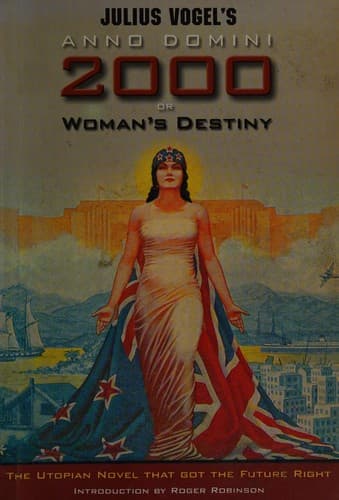
Anno Domini 2000; or, Woman's DestinyVogel, Julius, Sir
Science
Anno Domini 2000; or, Woman's Destiny
Vogel, Julius, Sir
Feminist fiction; New Zealand -- Fiction; Two thousand, A.D. -- Fiction; Utopian fiction; Utopias -- Fiction; Women -- Fiction
Quite recovered from her last night's agitation, Hilda looked her best
in a charmingly fashioned dressing-gown as she entered the room where
Mrs. Hardinge was waiting to receive her.
"My dear, dear girl," said that lady as she embraced her, "I am
delighted. You are well again? I need not ask. Your looks proclaim it.
You are the heroine of the hour. The Emperor learnt everything last
night, and the papers all over the world are full of it to-day. Maud
says the telegrams are from every part of the globe, not only within our
own empire, but from Europe, and the United States, and South America.
You are a brave girl."
"Pray do not say so, Mrs. Hardinge. I only did my duty--what any one in
my place would have done. Tell me all that has happened."
Mrs. Hardinge, nothing reluctant, replied with animated looks and
gestures. "Laurient has told me everything. You instructed the officer,
it seems, to keep a watch over only the occupants of the three further
rows. Lord Reginald had left those, and was approaching you. The
officer, following your words literally, allowed him to leave unwatched.
Some sixty only of the people were placed under espionage. Nearly every
one of the rest who were present is supposed to have left Melbourne,
including Lord Reginald. We sent to his house to arrest him, but he had
departed in one of his fastest long-distance air-cruisers. It is
supposed that he has gone to Europe, or to America, or to one of his
remote estates in the interior of this continent. I am not sure that the
Emperor was displeased at his departure. When the intelligence reached
him, he said to me, 'That will save Miss Fitzherbert from appearing in
public to give evidence. As for the rest, it does not matter. They have
been fooled to serve that man's ends.' So now they are free. But their
names are known; indeed, their ridiculous appearance is immortalised. A
likeness was taken of every one, but the _tout ensemble_ is superbly
grotesque. It is well so few people know the secret of artificial
magnetism."
Hilda showed Mrs. Hardinge the Emperor's magnificent present, and asked
what was she to do. Should she write a letter of thanks?
"Do so," said the shrewd woman of the world. "Who knows that he will not
value the acknowledgment as you value the gift?"
Again Hilda's face was suffused in red. "I must go away," she said to
herself, "until I can better command myself." Then she begged Mrs.
Hardinge not to mention about the Emperor's gift. "I shall only tell
Maud of it. I felt it was right to tell you."
"Of course it was," said Mrs. Hardinge; "but it may be well not to
mention it further. There are thousands of persons who honour and admire
you; but there are thousands also who already envy you, and who will not
envy you the less because of this great deed."
Then she told Hilda that the Emperor wished to do her public honour by
making her a countess in her own right. Hilda shrank from the
distinction. "It will lose me my seat in Parliament," she said.
Public-domain text, read in full here on John Shaqi.
Reviews
Reviews
No reviews yet
Be the first to share your thoughts on this work.
Elsewhere in the archive
Join the Discussion
Join the discussion
Sign in to leave a comment or review.
Sign InorCreate an account