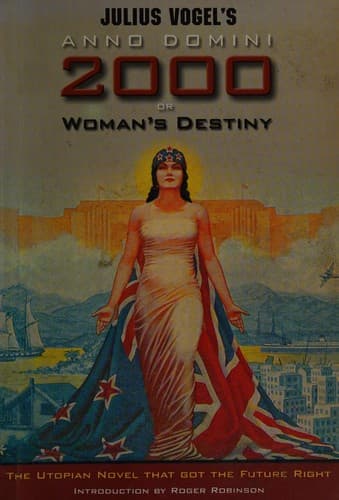
Anno Domini 2000; or, Woman's DestinyVogel, Julius, Sir
Science
Anno Domini 2000; or, Woman's Destiny
Vogel, Julius, Sir
Feminist fiction; New Zealand -- Fiction; Two thousand, A.D. -- Fiction; Utopian fiction; Utopias -- Fiction; Women -- Fiction
"No. You will only have to stand for re-election, and no one will oppose
you."
"But," said the girl, "I am not rich enough."
"If report is correct, you soon will be. The river-works in New Zealand
are nearly finished; they will make you, it is said, a millionaire."
"I had forgotten them for the moment, but it is not safe to count on
their success until the test is actually made. This reminds me that they
will be finished next week; and my friends in New Zealand think that my
sister and I ought to be present, if only in honour of our dear
grandfather, who left us the interest we hold in the river. Can you
spare me for ten days?"
"Of course I can, Hilda dear. The change will do you good. Laurient is
going. He is said to have an interest in the works. And Montreal is
going also. He too had an interest, but I think he parted with it."
They discussed whether Hilda should go to the fête that was to be held
on Monday to celebrate the centenary of the completion of the irrigation
of the Malee Scrub Plains.
These plains were once about as desolate and unromantic a locality as
could be found; but a Canadian firm, Messrs. Chaffey Brothers, had
undertaken to turn the wilderness into a garden by irrigation, and they
had entirely succeeded. An enormous population now inhabited the
redeemed lands, and a fête was to be held in commemoration of the
century that had elapsed since the great work was completed. The Emperor
himself had agreed to be there. Hilda begged to be excused. Her nerves
were shaken. She would dread the many congratulations she would receive
and the requests to repeat over and over again the particulars of the
scene which inspired her now with only horror and repulsion.
"You must not show yourself to-day," Mrs. Hardinge said; "and I will cry
you off to-morrow on the ground of illness. Next day go to New Zealand,
and by the time you return you will be yourself again."
"You may say too I am abundantly occupied," said Hilda archly as Maud
entered the room with an enormous package of open telegrams in her
hands. "Dear Hilda, you do look well to-day. I am so pleased," said the
delighted girl as she flung down the telegrams and embraced her sister.
There was something singularly pathetic in the love of these two girls.
Mrs. Hardinge left them together. Hilda showed the medallion in strict
confidence. Maud was literally enraptured with it. "How noble, how
handsome, he is! I know only one other man so beautiful." Then she
paused in confusion; and Hilda rather doubted the exception, though she
knew it was their old playfellow Montreal who was intended.
"Who is the traitor," she said, "you dare to compare with your
Sovereign?"
Maud, almost in tears, declared she did not mean what she said. The
Emperor was very handsome.
"Do not be ashamed, my dear, to be true to your feelings," said Hilda
sententiously. "A woman's heart is an empire of itself, and he who
rules over it may be well content with a single loyal subject."
Public-domain text, read in full here on John Shaqi.
Reviews
Reviews
No reviews yet
Be the first to share your thoughts on this work.
Elsewhere in the archive
Join the Discussion
Join the discussion
Sign in to leave a comment or review.
Sign InorCreate an account