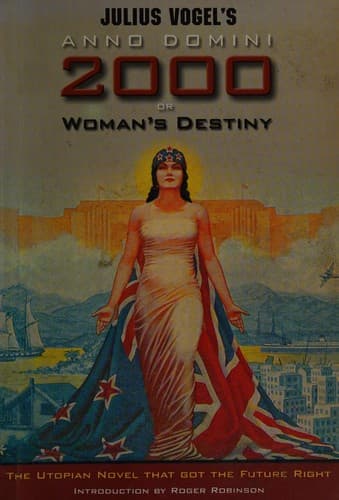
Anno Domini 2000; or, Woman's DestinyVogel, Julius, Sir
Science
Anno Domini 2000; or, Woman's Destiny
Vogel, Julius, Sir
Feminist fiction; New Zealand -- Fiction; Two thousand, A.D. -- Fiction; Utopian fiction; Utopias -- Fiction; Women -- Fiction
"Nonsense, Hilda! Do not tease me. An emperor, too, may rule over a
woman's heart."
This was rather carrying the war into the opposite camp. Miss
Fitzherbert thought it time to change the subject. They discussed the
telegrams. Then Maud told Hilda how frightfully agitated Laurient was
the previous evening. Finally they decided they would go to New Zealand
the day after the next. They debated if they should proceed in their own
air-cruiser or in the public one that left early every morning. It was
about a sixteen hours' journey in the public conveyance, but in their
own it would take less time. Besides, they wished to go straight to
Dunedin, where the girls had a beautiful residence, and where their
friends were chiefly located. Hilda represented Dunedin in the New
Zealand Parliament, and local government honours had been freely open to
her; but, under the tutelage of Mrs. Hardinge, she had preferred
entering into federal politics, though she continued in the New Zealand
Parliament. Most of the leading federal statesmen interested themselves
with one or other Dominion government. There was such an absence of
friction between the federal and the separate dominion governments that
no inconvenience resulted from the dual attention, while it led to a
more intimate knowledge of local duties. Maud bashfully remembered that
Lady Taieri had asked them to go to Dunedin on her beautiful cruiser.
"She was making up a party," said Maud; "and she mentioned that Colonel
Laurient and Lord Montreal were amongst the number."
Hilda saw the wistful look in Maud's eyes. "Let us go with Lady Taieri,"
she said; and so it was arranged.
CHAPTER VIII.
AIR-CRUISERS.
We trust our readers will not be wearied because it is necessary to give
them at some length an explanation concerning the aerial machines to
which reference has so often been made as air-cruisers. It need scarcely
be said that from time immemorial a great deal of attention has been
directed to the question whether aerial travelling could he made
subservient to the purposes of man. Balloons, as they were called, made
of strong fabrics filled with a gas lighter than air, were to some
extent used, but rarely for practical purposes. They were in
considerable request for military objects, and it is recorded that
Gambetta managed to get out of Paris in a balloon when that city was
beleaguered by the German army in 1871. The principle of the balloon
was the use of a vessel which, weighing, with all its contents, less
than a similar volume of the atmosphere, would consequently rise in the
air. But evidently no great progress could be made with such an
apparatus. The low specific gravity of the atmosphere forbade the hope
of its being possible to carry a heavy weight in great quantity on a
machine that depended for its buoyancy on a less specific gravity.
Besides, there was danger in using a fabric because of its liability to
irreparable destruction by the smallest puncture.
Public-domain text, read in full here on John Shaqi.
Reviews
Reviews
No reviews yet
Be the first to share your thoughts on this work.
Elsewhere in the archive
Join the Discussion
Join the discussion
Sign in to leave a comment or review.
Sign InorCreate an account