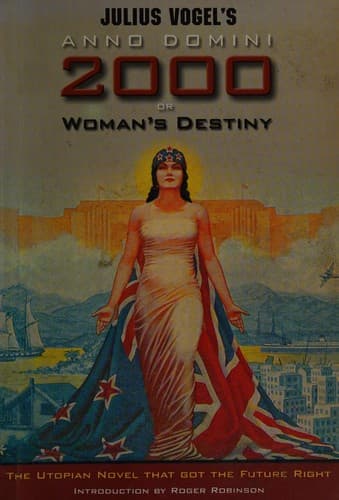
Anno Domini 2000; or, Woman's DestinyVogel, Julius, Sir
Science
Anno Domini 2000; or, Woman's Destiny
Vogel, Julius, Sir
Feminist fiction; New Zealand -- Fiction; Two thousand, A.D. -- Fiction; Utopian fiction; Utopias -- Fiction; Women -- Fiction
New Zealand was celebrated for the wonderfully curative power of its
waters. At Rotomahana, Te Aroha, and Waiwera in the North Island, and at
Hammer Plains and several other localities in the Middle Island
innumerable springs, hot and cold, existed, possessing a great variety
of medicinal properties. There was scarcely a disease for which the
waters of New Zealand did not possess either cure or alleviation. At one
part of the colony or another these springs were in use the whole year
round. People flocked to them from all quarters of the world. It was
estimated that the year previous to the commencement of this history,
more than a million people visited the various springs. Rotomahana, Te
Aroha, and Waiwera were particularly pleasant during the months of
October, November, and December. Hilda proposed passing nearly three
weeks at each. Rotomahana was a city of hotels of all sizes and
descriptions. Some were constructed to hold only a comparatively few
guests and to entertain them on a scale of great magnificence. Every
season these houses were occupied by distinguished visitors. Not
infrequently crowned heads resorted to them for relief from the maladies
from which even royalty is not exempt. Others of the hotels were of
great size, capable indeed of accommodating several thousands of
visitors. The Grandissimo Hotel comfortably entertained five thousand
people. Most of the houses were built of ground volcanic scoria, pressed
into bricks. Some of them were constructed of Oamaru stone, dressed with
a peculiar compound that at the same time hardened and gave it the
appearance of marble. The house that Hilda took appeared like a solid
block of Carrara marble, relieved with huge glass windows and with
balconies constructed of gilt aluminium. Balconies of plain or gilt
aluminium adorned most of the hotels, and gave them a very pretty
appearance. Te Aroha was a yet larger city than Rotomahana, as, besides
its use as a health resort, it was the central town of an extensive and
rich mining district. Waiwera was on a smaller scale, but in point of
appearance the most attractive. Who indeed could do justice to thy
charms, sweet Waiwera? A splendid beach of sand, upon which at short
intervals two picturesque rivers debouched to the sea, surrounded with
wooded heights of all degrees of altitude, and with many variations in
the colour of the foliage, it is not to be wondered at that persons
managed in this charming scene to forget the world and to reveal
whatever of poetry lay dormant in their composition. Few who visited
Waiwera did not sometimes realise the sentiment--
"I love not man the less, but nature more."
Public-domain text, read in full here on John Shaqi.
Reviews
Reviews
No reviews yet
Be the first to share your thoughts on this work.
Elsewhere in the archive
Join the Discussion
Join the discussion
Sign in to leave a comment or review.
Sign InorCreate an account