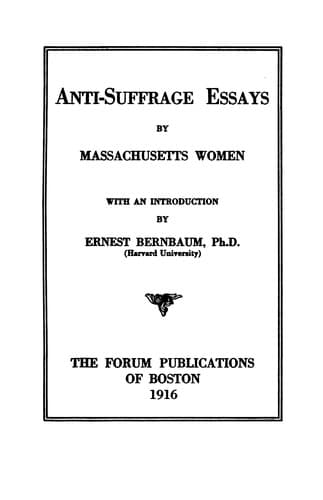
Women -- Massachusetts; Women -- Suffrage -- United States; Women's Anti-Suffrage Association of Massachusetts
It is surprising that social workers and club women in larger numbers
are not awake to this danger; but, as has well been said, deciding
wisely on this question is not a matter of intelligence but of
information; and it is easier to accept suffrage theories and the
_mis_information which suffrage orators generously supply as to how
suffrage _will_ work than to study the happenings in suffrage states and
learn for oneself how it _does_ work.
Social workers and club women know their present strength and how many
good laws they have helped to put on the statute books. What they
seemingly do not realize is how quickly this power will be gone when
they divide into political parties. Many of them are apparently too
ignorant of politics to understand that _as voters_ it is only those men
for whom they will vote that they can influence.
A despatch from Topeka, Kansas, describing the recent campaign in that
state says that three years ago the Kansas Federation of Women's Clubs
lined up solidly for suffrage, and won it--and that they have not been
lined up solidly for anything since! Instead of throwing their influence
as a unit for good legislation, as women's clubs are wont to do in male
suffrage states, these women are divided into Republicans, Democrats,
Progressives, and Socialists, and the friction among them is greater
than ever before.
At the time Jane Addams joined the Progressive party it was very
striking that such ardent suffragists as Ida Husted Harper and Edward
Devine, editor of "The Survey," should have protested publicly in the
strongest terms against her action. They realized perfectly that
political partisanship narrows a woman's sphere of influence, and that
Miss Addams as a member of the Progressive party could exercise much
less influence upon Democrats and Republicans. She had before been able
to reach men of all parties, but now her field had suddenly become
immensely restricted in its scope. And while Mrs. Harper and Mr. Devine
were perfectly willing, even eager, that other women should enter
politics and ally themselves with political parties, Miss Addams was too
valuable to the causes they had at heart, namely, suffrage and social
service, for them to view with equanimity such a narrowing of her field
of influence.
In an article on the "Legislative Influence of Unenfranchised Women," by
Mary R. Beard, which appeared in the "Annals of the American Academy of
Political and Social Science," for November, 1914, Mrs. Beard, although
an ardent suffragist, admits that women without the vote have been a
strong influence toward good legislation. She says:
Public-domain text, read in full here on John Shaqi.
Reviews
Reviews
No reviews yet
Be the first to share your thoughts on this work.
Join the Discussion
Join the discussion
Sign in to leave a comment or review.
Sign InorCreate an account