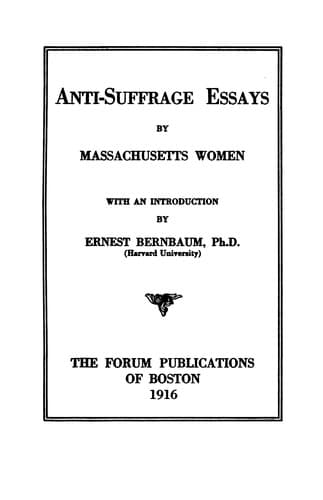
Women -- Massachusetts; Women -- Suffrage -- United States; Women's Anti-Suffrage Association of Massachusetts
"National as well as state legislation has been affected by women, if
the testimony of men like Harvey W. Wiley is accepted. In his campaign
for pure food laws, he stated repeatedly that his strongest support
came from women's organizations. That support was not passive and moral,
merely expressed to him privately, but these women inundated congress
with letters, telegrams, petitions, pleading for the passage of the laws
in question. These communications were presented to congress by their
recipients who often urged as their reason for supporting pure food laws
the appeals of women whose interests in food should not be ignored.
"The Consumers' League of New York helped the national food committee to
defeat a mischievous amendment to the Gould bill, which requires that
all package goods should be labelled as to the amount of their contents.
"Mrs. Albion Fellowes Bacon, of Indiana, practically single-handed,
secured the first tenement house laws of value for Evansville and
Indianapolis. She did this before the National Housing Association, of
which she is now a director, was formed. The recent improvements in the
Indiana housing legislation are due apparently to her continued
leadership and to the public opinion which she has helped to create. In
her case it was personal initiative and moral persuasion.
"Another example of personal influence on legislation exerted by women
is that of Frances Perkins, of New York, in her fight for the fifty-hour
bill for the women workers of her state. Unlike Mrs. Bacon, Miss Perkins
represented a society--the Consumers' League--which asked for this
measure, and she was supported in her demand by the Women's Trade Union
League and other organizations. The measure would have been defeated, as
is widely known and acknowledged in New York, had it not been for the
personal sagacity and watchfulness of Miss Perkins.
"The social service committee of the 'American Club Woman' states that
in the first year of its existence it has done important and effective
work. It was largely responsible for the passage of an ordinance by city
councils regulating dance halls.
"Similar activities, both positive and negative, can be discovered in
the records of practically every woman's association not organized for
purely literary purposes."
We all know that this is true. Mrs. Beard also says:
"The woman's influence lies not in physical force, but in the occasional
subservience of the mind of man to the actual presence of a moral
force."
Public-domain text, read in full here on John Shaqi.
Reviews
Reviews
No reviews yet
Be the first to share your thoughts on this work.
Join the Discussion
Join the discussion
Sign in to leave a comment or review.
Sign InorCreate an account