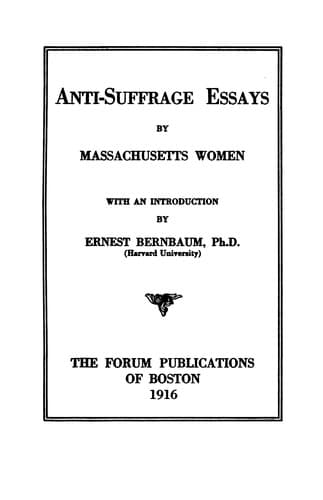
Women -- Massachusetts; Women -- Suffrage -- United States; Women's Anti-Suffrage Association of Massachusetts
The suffragist, who is so often the unmarried or childless woman, here
objects that women could also vote. But it is practically impossible for
women as a sex to undertake the regular and frequent political duties.
If the highest efficiency in private life is to be striven toward, women
must regard themselves as a sort of emergency corps, prepared to meet
the unexpected; for illness, accidents, temptation, sorrow--all the
disturbances of domestic life--do not come at stated intervals. Anyone
can readily see that for women private duty would constantly conflict
with public duty. To become an efficient political unit, a woman would
have to set aside much time and strength upon organizing and bringing
out the woman's vote. There would be the splitting up of women into
rival political groups on class, race, or religious lines, the
dissipation of energies and strain of contention for women who in
America already reach with sad frequency the breaking point of nerves
and body.
In contrast to such obligatory activity for all women, consider the
field of voluntary non-partisan activity now open to the single woman,
the woman of leisure, and to every woman at such times as her family
duties permit. Indeed the germ of the true woman's movement lies in the
activities of such organizations as education societies, playground
associations, municipal leagues, and so forth, which are only in their
first stages of usefulness. Here is ample scope and outlet for talents
and energy.
Our sex, if kept out of politics, has the opportunity in these days when
we prate so much about peace, to set about disarming distrust and
discord within our own borders. Shall we not dream of a united American
womanhood? We twentieth century women may take a noble stride toward it,
if we will, by working for those causes that disregard the divisions of
race, religion, and politics. Is it surprising that the anti-suffragist
sees a vast, unexhausted field for woman's influence outside the
political? No wonder that to the suffragist's craving for a new sphere
and new rights she opposes the plea of old duties unfulfilled and
existing opportunities neglected.
Public-domain text, read in full here on John Shaqi.
Reviews
Reviews
No reviews yet
Be the first to share your thoughts on this work.
Elsewhere in the archive
Join the Discussion
Join the discussion
Sign in to leave a comment or review.
Sign InorCreate an account