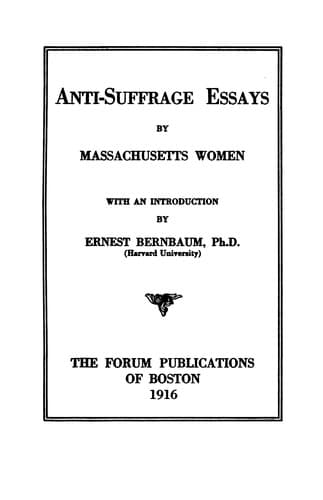
Women -- Massachusetts; Women -- Suffrage -- United States; Women's Anti-Suffrage Association of Massachusetts
We do not believe with Mr. Creel that "the old fashioned idea of home is
bunk," nor do we agree with Mr. Roger Sherman Hoar, who is reported as
saying that "woman suffrage, by doubling the electorate, will double the
opportunities of each man for political interest." He goes on to say
that when a man's wife becomes a voter he will talk politics with her
and will give more weight to her political opinion, thereby learning the
home point of view on home matters. Is it probable that a man who has
not spent enough time with his wife to know what the home point of view
is before she has a vote, would be induced to spend more time there
because she had? It is much more likely that he would spend less time
there, since without political duties she was unable to make his home
attractive, and with political duties she would have even less time to
give to the making of a good home. Further on we read: "With increased
interest in matters political"--this increase to be brought about by
giving women the vote--"the men will scrutinize their public servants
more carefully." What becomes here of the contention of the suffragists
that the _ballot_ is the only thing that wakens interest in good
government, if the men who already have the ballot are not interested in
good government, but need to have the women enfranchised before they can
have a real interest in matters political?
No, woman must specialize in the home. I am not speaking of those who
"by choice or accident have missed the highest privilege of womanhood,"
as Mr. Pyle ably puts it, but of the great majority of women. To my mind
the advantages of a properly conducted home life far outweigh the
advantages of any institution, no matter how good. That I am not alone
in this opinion is witnessed by the fact that the trustees of the best
orphan asylums are making every effort to diminish the number of
children in their institutions and to place the children in homes. They
have learned that even a poorly conducted home is better than a well
conducted asylum, and that they have no right to deprive children of the
benefits of family life. Yet the feminists, closely allied with the
suffragists, advocate putting children of tender age into institutions,
where, according to them, they will be better cared for than at home.
"If they are well, the institution nurse is as good; if they are ill,
she is much better than the mother" says one suffrage leader. Those of
us who have known better can only pity people who hold such beliefs. To
them mother love can have no meaning. Yet those of us who have felt this
mother love, know what a guiding star it has been, and must always
continue to be, brightening steadily as the years go by, and beckoning
us more persistently than ever to higher ideals when it is only a
memory. Who would dare deprive our children of this precious heritage?
Only the unknowing.
Public-domain text, read in full here on John Shaqi.
Reviews
Reviews
No reviews yet
Be the first to share your thoughts on this work.
Elsewhere in the archive
Join the Discussion
Join the discussion
Sign in to leave a comment or review.
Sign InorCreate an account