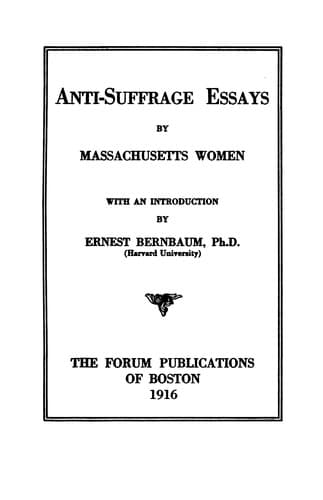
Women -- Massachusetts; Women -- Suffrage -- United States; Women's Anti-Suffrage Association of Massachusetts
To the same interviewer, Miss Eleanor Gates, of the Empire State
Campaign Committee, said: "It's unfortunate that the parents of these
babies did not take out licenses to be parents.... But more unfortunate,
to my mind, than an omission of the license, is the fact that motherhood
should ever be counted a crime.... And, when all is said and done, I,
myself, respect the unmarried woman with a child more than I do the
married woman with a poodle."
These are the utterances of conspicuous leaders of the younger, more
radical wing of the woman suffrage movement; and no one who follows with
any care their speeches and writings can claim that they are out of
character. Is it unfair to say such utterances confuse moral values and
weaken the sense of individual responsibility?
This regret that "motherhood should ever be counted a crime" is often
more tersely expressed in the phrase "right to motherhood," first made
fashionable, I believe, by Mr. Bernard Shaw. It was given publicity last
June through an address made by Prof. W. I. Thomas of the University of
Chicago at the banquet held by the Chicago Equal Suffrage Association in
honor of the National Executive Council. Professor Thomas said, "in
substance"--I quote the _Woman's Journal_--"that many women who could
not marry were earnestly desirous of children, and that it ought to be
recognized that monogamy was not the only relation in which it was
respectable for a woman to have a child." The National Association, as
is well known, is the conservative wing of the wrangling suffragist
army, and contains most of those "middle-aged reformers" whom the
"younger generation" dispose of so easily by saying that they have not
kept up with the times. Miss Alice Stone Blackwell promptly combatted
the speaker's opinions, and the _Woman's Journal_ reports that she was
heartily applauded.
But Professor Thomas is not so easily disavowed. A ten-page pamphlet,
"Votes for Women," published by the Massachusetts Woman Suffrage
Association, is of his authorship. In _The Case for Woman Suffrage_, a
bibliography with critical comments, published by the National College
Equal Suffrage League in 1913, eighty-eight lines are given to
quotations from Professor Thomas's works, while Miss Blackwell's receive
only forty. Such comparisons may seem trifling, but they are
significant. If any one doubts the hold of the feminist ideas upon many
of the most influential suffragists, he may be convinced by himself
examining _The Case for Woman Suffrage_. Anti-suffragists are often
accused of arguing from isolated, casual utterances. For my part, I find
it impossible to reproduce, by any quotations, the impression of
recklessness left by habitually reading publications, both American and
English, in sympathy with suffrage.
Public-domain text, read in full here on John Shaqi.
Reviews
Reviews
No reviews yet
Be the first to share your thoughts on this work.
Elsewhere in the archive
Join the Discussion
Join the discussion
Sign in to leave a comment or review.
Sign InorCreate an account