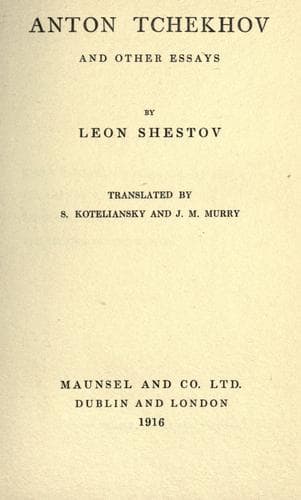
Chekhov, Anton Pavlovich, 1860-1904; Dostoyevsky, Fyodor, 1821-1881; Philosophy; Russian literature -- History and criticism
As a matter of
fact, Hegel and Schopenhauer, each in his own way, partly attempted to
make an admission of this kind, but they derived small profit from it.
Let us try to draw some conclusions from the foregoing. Certainly,
while logic can be useful, it would be unjustifiable recklessness
to refuse its services. Nor are the conclusions devoid of interest,
as we shall see. First of all, when you speak, never trouble to be
consistent with what you said before: that will put an unnecessary
check upon your freedom, which, without that additional fetter, is
already chained in words and grammatical forms. When you are listening
to a friend or reading a book, do not assign great value to individual
words or even to phrases. Forget separate thoughts, and give no great
consideration even to logically arranged ideas. Remember that though
your friend desires it, he cannot express himself save by ready-made
forms of speech. Look well to the expression of his face, listen to
the intonation of his voice--this will help you to penetrate through
his words to his soul. Not only in conversation, but even in a written
book, can one over-hear the sound, even the timbre of the author's
voice, and notice the finest shades of expression in his eyes and
face. Do not fasten upon contradictions, do not dispute, do not demand
argument: only listen with attention. In return for which, when you
begin to speak, you also will have to face no dispute, nor to produce
arguments, which you know well you neither have nor could have. So you
will not be annoyed by having pointed out to you your contradictions
which you know well were always there, and will always be there, and
with which it is painful, nay quite impossible, for you to part. Then,
then--and this is most important of all--you will at last be convinced
that truth does not depend on logic, that there are no logical truths
at all, that you therefore have the right to search for what you like,
how you like, without argument, and that if something results from your
search, it will not be a formula, not a law, not a principle, not even
an idea! Only think: while the object of search is 'truth,' as it is
understood nowadays, one must be prepared for anything. For instance,
the materialists will be right, and matter and energy are the basis
of the world. It does not matter that we can immediately confound
the materialists with their conclusions. The history of thought can
show many cases of the complete rehabilitation of opinions that have
been cast off and reviled. Yesterday's error may be to-morrow's truth,
even a self-evident truth. And apart from its content, wherein is
materialism bad? It is a harmonious, consistent, and well-sustained
system. I have already pointed out that the materialistic
conception of the world is just as capable of enchanting men as any
other--pantheistic or idealistic. And since we have come so far, I
confess that in my opinion no ideas at all are bad in themselves: so
Public-domain text, read in full here on John Shaqi.
Reviews
Reviews
No reviews yet
Be the first to share your thoughts on this work.
Join the Discussion
Join the discussion
Sign in to leave a comment or review.
Sign InorCreate an account