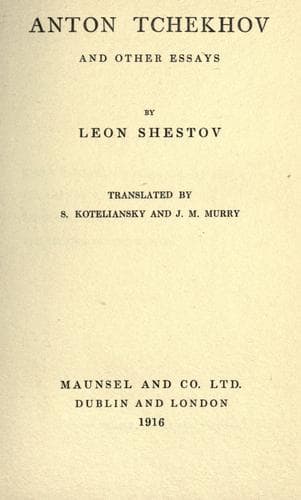
Chekhov, Anton Pavlovich, 1860-1904; Dostoyevsky, Fyodor, 1821-1881; Philosophy; Russian literature -- History and criticism
far I have been able to follow with pleasure the development of the
idea of progress to the accompaniment of factories, railways, and
aeroplanes. Still, it seems to me childish to hope that all these
trivialities--I mean the ideas--will become the object of man's serious
seeking. If that desperate struggle of man with God and the world
were possible, of which legend and history tell--think of Prometheus
alone--then it was not for truth and not for the idea. Man desires to
be strong and rich and free, the wretched, insignificant creature of
dust, whom the first chance shock crushes like a worm before one's
eyes,--and if he speaks of ideas it is only because he despairs of
success in his proper search. He feels that he is a worm, he fears that
he must again return to the dust which he is, and he lies, pretending
that his misery is not terrible to him, if only he knew the truth.
Forgive him his lie, for he speaks it only with his lips. Let him say
what he will, how he will; so long as we hear in his words the familiar
note of the call to battle, and the fire of desperate inexorable
resolution burns in his eyes, we will understand him. We are used to
decipher hieroglyphs. But if he, like the Germans of to-day, accepts
truth and the norm as the final goal of human aspiration, we shall also
know with whom we have to deal, were he by destiny endowed with the
eloquence of Cicero. Better utter loneliness than communion with such a
man. Yet such communion does not exclude utter loneliness; perhaps it
even assists the hard achievement.
XI
_I and Thou_
Public-domain text, read in full here on John Shaqi.
Reviews
Reviews
No reviews yet
Be the first to share your thoughts on this work.
Join the Discussion
Join the discussion
Sign in to leave a comment or review.
Sign InorCreate an account