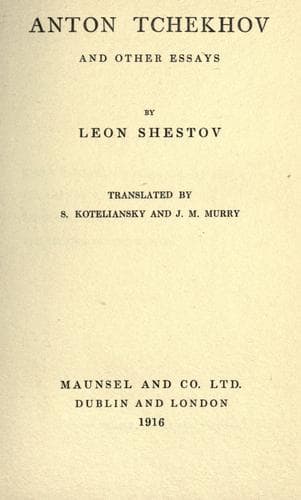
Chekhov, Anton Pavlovich, 1860-1904; Dostoyevsky, Fyodor, 1821-1881; Philosophy; Russian literature -- History and criticism
abyss of which we spoke, something might be found, were it not for
the giddiness. Therefore it is not so necessary to invent new methods
as to learn to look fearlessly into the depths, which always appear
unfathomable to the unaccustomed eye.
After all, unfathomability is not so entirely useless to man. It was
driven into our heads as children that the human mind could compass
only those things which are limited. But this only proves that we have
yet another prejudice to get rid of. If it comes to giving up the right
of abusing the materialists and of being taught by psychology, and
something else into the bargain--well, we are used to that. But in
return we may at last be granted a glimpse of the mysterious 'thou,'
and perhaps the 'I' will cease to be problematical as well. Patience
is a sickening thing; but remember the fakirs and the other worthies
of the same kind. They succeed by patience alone. And apparently
they arrive at something; but not at universal truths, I am ready to
vouch for that. The world has long been weary of universal truths.
Even 'truth' pure and simple makes no whisper in my ear. We must find
a way of escape from the power of every kind of truth. This victory
the fakirs tried to win. They can produce no arguments to prove their
right, for the visible victory was never on their side. One conquers
by bayonets, big guns, microscopes and logical arguments. Microscopes
and logic give the palm to limitation. And yet, though limitation often
strengthens, it also happens that it kills.
THE THEORY OF KNOWLEDGE
_The Theory of Knowledge as Apologetics_
The modern theory of knowledge, though it always consciously takes
its rise from Kant, has in one respect quite disregarded the master's
commandment. It is very strange that the theorists of knowledge,
who usually cannot agree among themselves upon anything, have as it
were agreed to understand the problem of knowledge quite otherwise
than Kant. Kant undertook to investigate our cognitive faculties in
order to establish foundations, in virtue of which certain existing
sciences could be accepted, and others rejected. One may say that the
second purpose was chief. Hume's scepticism made him uneasy only in
theory. He knew beforehand that whatever theory of knowledge he might
invent, mathematics and the natural sciences would remain sciences and
metaphysics be rejected. In other words, his aim was not to justify
science but to explain the possibility of its existence; and he started
from the point of view that no one can seriously doubt the truths of
mathematics and natural science. But now the position is different. The
theorists of knowledge direct all their efforts towards _justifying_
scientific knowledge. Why? Does scientific knowledge really need
justification? Of course there are cranks, sometimes even cranks of
genius, like our own Tolstoi, who attack science; but their attacks
offend no one, nor do they cause alarm.
Public-domain text, read in full here on John Shaqi.
Reviews
Reviews
No reviews yet
Be the first to share your thoughts on this work.
Elsewhere in the archive
Join the Discussion
Join the discussion
Sign in to leave a comment or review.
Sign InorCreate an account