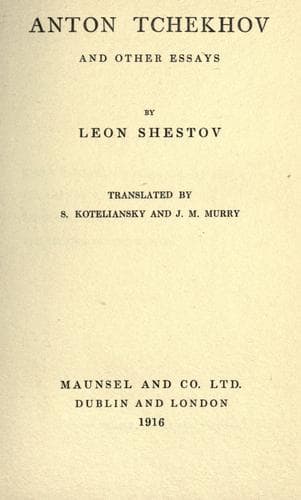
Chekhov, Anton Pavlovich, 1860-1904; Dostoyevsky, Fyodor, 1821-1881; Philosophy; Russian literature -- History and criticism
Scientists continue their researches as before; the universities
flourish; discovery follows discovery. And the theorists of knowledge
themselves do not spend sleepless nights in the endeavour to find
new justifications for science. Yet, I repeat, though they can come
to an understanding about practically nothing else, they amaze us
by their unanimity upon this point--they are all convinced that it
is their duty to justify science and exalt her. So that the modern
theory of knowledge is no longer a science, but an apology. And
its demonstrations are like those of apology. Once science must
be defended, it is necessary to begin by praising her, that is by
selecting evidence and data to show that science fulfils some mission
or other, but indubitably a very high and important one, or, on the
other hand, by painting a picture of the fate that would overtake
mankind, if it was deprived of science. Thus the apologetic element
has begun to play almost as large a part in the theory of knowledge
as it has done hitherto in theology. Perhaps the time is at hand when
scientific apologetics will be officially recognised as a philosophic
discipline.
But, _qui s'excuse s'accuse._ It is plain that all is not well with
science, since she has begun to justify herself. Besides, apologetics
are only apologetics, and sooner or later the theory of knowledge
will be tired of psalms of praise, and will demand a more complex and
responsible task, and a real labour. At present the theorists start
with the assumption that scientific knowledge is perfect knowledge,
and therefore the premisses upon which it is builded are not subject
to criticism. The law of causation is not justified because it appears
to be the expression of a real relation of things, nor even because we
have data at our disposal which could convince us that it does not and
will never admit exceptions, that uncaused effects are impossible. All
these things are lacking; but, we are told, they are not needed.
The chief thing is that the causal law makes science possible, while
to reject it means to reject science and knowledge generally, all
anticipation, and even, as some few hold, reason itself. Clearly, if
one has to choose between a slightly dubious admission on the one side
and the prospect of chaos and insanity on the other, there will be no
long hesitation. Apologetics, we see, has chosen the most powerful of
arguments, _ad hominem._ But all such arguments partake of one common
defect; they are not constant, and they are double-edged.
Public-domain text, read in full here on John Shaqi.
Reviews
Reviews
No reviews yet
Be the first to share your thoughts on this work.
Elsewhere in the archive
Join the Discussion
Join the discussion
Sign in to leave a comment or review.
Sign InorCreate an account