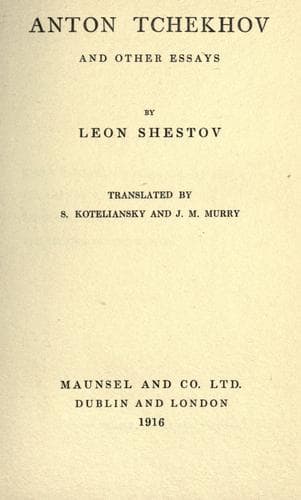
Chekhov, Anton Pavlovich, 1860-1904; Dostoyevsky, Fyodor, 1821-1881; Philosophy; Russian literature -- History and criticism
Mill, seeking to prove that all our sciences, even the mathematical,
have an empiric origin, brings forward the following consideration.
If on every occasion that we had to take twice two things, some deity
slipped one extra thing into our hands, we should be convinced that
twice two is not four but five. And perhaps Mill is right: perhaps we
should not divine what was the matter. We are much more concerned to
discover what is practically necessary and directly useful to us than
to search for truth. If a deity with each four things slipped a fifth
into our hands, we should accept the additional thing and consider
it natural, intelligible, necessary, impossible to be otherwise. The
very uniformity in the sequence of phenomena observed by the empirical
philosophers was also slipped into our hands. By whom? When? Who dares
to ask? Once the law is established no one is interested in anything
any more. Now we can foretell the future, now we can use the thing
slipped into our hands, and the rest--cometh of the evil one.
_Philosophers and Teachers_
Every one knows that Schopenhauer was for many years not only not
recognised, but not even read. His books were used for waste-paper.
It was only towards the end of his life that he had readers and
admirers--and, of course, critics. For every admirer is at bottom a
most merciless and importunate critic. He must understand everything,
make everything agree, and of course the master must supply the
necessary explanations. Schopenhauer, who did not have the experience
of being a master till his old age, at first behaved very benevolently
to his disciples' questions and patiently gave the explanations
required. But the further one goes into the forest, the thicker are
the trees. The most loyal perplexities of his pupils became more and
more importunate, until at last the old man lost patience. 'I didn't
undertake to explain all the secrets of the universe to every one who
wanted to know them,' he once exclaimed, when a certain pupil persisted
in emphasising the contradictions he had noticed in Schopenhauer. And
really--is a master obliged to explain everything? In Schopenhauer's
words we are given an answer, not ambiguous. A philosopher not only
cannot be a teacher, he does not want to be one. There are teachers
in schools, in universities: they teach arithmetic, grammar, logic,
metaphysics. The philosopher has quite a different task, one which does
not in the least resemble teaching.
_Truth as a Social Substance_
Public-domain text, read in full here on John Shaqi.
Reviews
Reviews
No reviews yet
Be the first to share your thoughts on this work.
Elsewhere in the archive
Join the Discussion
Join the discussion
Sign in to leave a comment or review.
Sign InorCreate an account